
Reading the full series? Browse all volumes here.
Before diving in — Vol. 2 sets out the author’s framing and caveats.
The first of the three principles in Sanpo Yoshi is Uri-te Yoshi. Taken at face value, “Uri-te” simply means seller.
Yet in the literature and primary sources that deal with the Ohmi Shonin, the term appears to carry meaning beyond its literal sense: it refers not merely to a seller in the abstract, but to the Ohmi Shonin themselves. In other words, the three parties in Sanpo Yoshi map onto specific roles — Uri-te (seller) = Ohmi Shonin, Kai-te (buyer) = the individuals and entities who purchased goods from the Ohmi Shonin, and Seken (society) = the local community and the broader social order.
As for Uri-te Yoshi — the theme of this installment — the author’s impression is that, at least in general discourse within Japanese society, it tends to receive less emphasis than the other two principles, Kai-te Yoshi and Seken Yoshi, when Sanpo Yoshi is discussed. This is, of course, a matter of popular reception rather than academic treatment, where the picture is quite different.
The author holds that Uri-te Yoshi is no less essential a component of Sanpo Yoshi than the other two. It is this conviction that the present installment seeks to examine in depth.
The Religious Sensibility Behind the Tenho and Family Precepts
As noted in “Sanpo Yoshi III,” the Ohmi Shonin maintained strict discipline precisely because they conducted business far from home. One of the means by which they did so was devotion to Japanese religious tradition, centered on Jodo Shinshu Buddhism.
Even in contemporary Japan, it is not uncommon for elderly people to tell their grandchildren: “Oten-to-sama ga mite iru” — “The sun is watching.” Or: “Kami-sama/Hotoke-sama ga mite iru” — “The gods/Buddha are watching.” Or: “Gosenzosamaga mite iru” — “Your ancestors are watching.” The message implicit in all these expressions is that someone is always watching, even where no human eye can see — and that one must therefore never do wrong.
Christian societies have their analogues. In that tradition, however, the divine gaze carries not only the sense of surveillance but also that of God’s love and grace. The Japanese religious idiom of “God is watching” tends, by contrast, to lean heavily toward the surveillant meaning.
Many Ohmi Shonin proprietors admonished their apprentices and employees (Banto and Detchi) to revere and worship the gods and Buddha — an injunction that, in the author’s reading, comes closer to the Christian sense of the divine as both loving and watchful. Through faith in the existence of the divine, the Ohmi Shonin are thought to have practiced constant self-examination: a guard against wrongdoing, and against conducting their trade in ways unworthy of the name.
The more practical instruments for maintaining and strengthening this discipline were the Tenho (shop code) and the Kakun (family precepts). The Tenho was the “law” of the “shop” — that is, of the company. It set out the rules that apprentices and employees were expected to observe. The Kakun, meanwhile, was the teaching of the household, and in most cases it denotes what a merchant family’s head sought to transmit to the next generation and beyond.
In the case of Ohmi Shonin businesses and households, both the Tenho and the Kakun contained rules and teachings for conducting commerce. As one example, the author wishes to revisit the letter that Jihei-sogan Nakamura left for his heir, which was introduced in the previous installment. In modern Japanese, it reads:
“Even when traveling to distant provinces for trade, you must not think only of your own profit on the goods you have brought. Think always of how every person in that land might wear them with pleasure. Do not seek high returns. In all things, trust to the grace and workings of Heaven, and to the natural course of events. Simply and wholeheartedly, you must hold dear the people of wherever you find yourself.” *¹
The passage touches on faith, but at the same time it cautions against extracting more profit than is necessary.
To repeat a point made earlier: since the Ohmi Shonin were conducting business away from home, to earn a reputation for gouging — and to be resented for it — would have been self-defeating. It would not have led to a sustainable business. Rather than take that path, the teaching urges that profit be kept thin and that earning the affection of the people come first. The author reads in this passage an implicit argument: that once a merchant is genuinely loved and goods begin to move, he can aspire to a fixed shop of his own, rather than remaining a traveling trader.
It is also worth noting that academic literature frequently observes that the Ohmi Shonin, given this tendency to avoid large profits on any single transaction, naturally gravitated toward a high-volume, low-margin model of commerce. *²
Uri-te Yoshi Requires That Employees Feel Secure
The Tenho and Kakun did not exist solely to enforce discipline among successors and employees. They also served to create an environment in which employees could apply themselves to their work with peace of mind. A prime example of this is Benchu — the enterprise that would later become Itochu Corporation and Marubeni Corporation.
Chubei Ito, the first-generation head of Benchu, established the shop’s Tenho in 1872. *³ In it, Ito stipulated that the profits earned by the shop would be distributed equally among three parties: the Ito main family, the shop’s reserve fund, and the employees. It should be noted that one source places the formal codification of this “three-way profit distribution” in 1875. *⁴ In 1893, the equal division was revised, and the ratio among the main family, the shop reserve, and the employee dividend was changed to 5:3:2.
There are those who regard this practice of distributing profits among the respective parties as remarkable for its time. Kunitoshi Suenaga, Professor Emeritus at Doshisha University, describes it as “the traditional profit-sharing system of the Ohmi Shonin.” *⁵
Also worth noting — though not directly connected to the Tenho — is the fact that Benchu began holding regular meetings from 1885 onward. Employees of every rank were permitted to speak freely at these gatherings. Furthermore, on days whose date contained a one or a six, a “Sukiyaki gathering” was held — an occasion on which everyone, regardless of seniority or the formalities of the table, simply enjoyed meat and sake together. This too can be read as a measure taken by Ito to cultivate an environment in which employees could do their work with ease; seen through a contemporary lens, it might also be understood as an early form of employee welfare.
This attitude of caring for one’s employees was not unique to Ito. Evidence suggests that at least some Ohmi Shonin of the Meiji period (1868–1912) held similar convictions. The following case illustrates the point.
In 1900, Chuemon Suzuki — an Ohmi Shonin who ran a sake brewery — presented a “Letter of Appreciation” (Irojo) to Mohei Kogame, an employee who was retiring after forty-five years of service. *⁶ The letter expressed gratitude for Kogame’s long years of dedication, and stated that henceforth Suzuki would provide him with an annual sum of one hundred yen. It further stipulated that should Kogame predecease his wife, she would continue to receive half that amount for as long as she lived. A precise conversion is difficult, but one hundred yen at the time would have been equivalent to several million yen today — or, in dollar terms, tens of thousands of dollars. *⁷
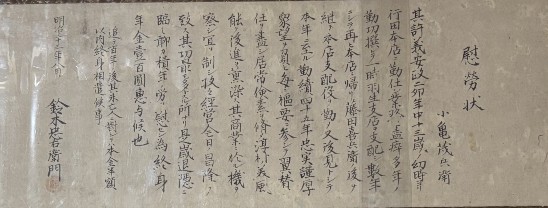
This represented the introduction of a corporate pension by an Ohmi Shonin, predating any other business entity in Japan. Until the discovery of the Irojo prepared by Suzuki, it had been assumed that the first corporate pension in Japan was introduced in 1905 by Kanegafuchi Boseki (Kanebo — a spinning company known in later years as Kanebo; the fraudulent accounting scandal that came to light in 2005 led to the transfer of its ancestral spinning [Boseki] business to another company). *⁸
Uri-te Yoshi demanded of all those on the selling side — proprietors and employees alike — both discipline and the cultivation of personal character. But it meant more than that: it encompassed the responsibility to create conditions in which those same sellers could dedicate themselves fully to their work.
OHYASHIMA is seeking information about the Ohmi Shonin
In connection with this series, OHYASHIMA welcomes information about the Ohmi Shonin. The author would be particularly grateful to hear from:
- Museum curators and archivists — in Japan or elsewhere — who hold collections related to the Ohmi Shonin
- Those who work for companies with ties to the Ohmi Shonin, or whose own ancestors were Ohmi Shonin
- Those who know of Ohmi Shonin merchants who conducted business outside Japan
OHYASHIMAは近江商人に関する情報を求めています
本連載にあたり、近江商人に関する情報を募集しています。たとえば、下記に該当する方はぜひご存じの情報をお寄せください。
- 日本国内外を問わず、近江商人に関する所蔵品がある博物館などの学芸員の方
- 近江商人と関連のある企業にお勤めの方、先祖などに近江商人がいらっしゃる方
- 日本国外でビジネスをした近江商人についてご存じの方
*1 Shonin no Kakun — Kodomotachi ni Tsutaetai Koto, Higashiomi City Ohmi Shonin Museum
*2 “Ohmi Shonin to wa,” Shiga University
*3 Itochu: Shonin no Kokoroe, Tsuneyoshi Noji, Shinchosha Shinsho
*4 “Keieisha no Keiei Rinen ni okeru Shukyo Rinri no Igi — Shodai Chubei Ito to Dokō Toshio wo Jirei toshite,” Seigo Tsujii, Nihon Keiei Rinrigakkai-shi, Vol. 9
*5 Ohmi Shonin-gaku Nyumon — CSR no Genryu ‘Sanpo Yoshi’ — Kaitei-ban, Kunitoshi Suenaga, Sunrise Shuppan
*6 From exhibition materials at the Ohmi Hino Shonin Museum
*7 “Meiji Jidai no Ichi-en wa Genzai Ikura ka. Tanjun na Kotae ga Hoshii.” Collaborative Reference Database
*8 Shiga Hochi Shimbun, digital edition, Nov. 13, 2013