

Founded in 2025, the company is headquartered in Yokohama and originated from the Okinawa Institute of Science and Technology Graduate University (OIST), where it also maintains a research and development center.
Ion-Trap Quantum Computing: Promise and Challenges
Conventional computers store data in bits that hold either a 0 or a 1. Quantum computers exploit a physical phenomenon known as “quantum superposition,” which allows quantum bits (qubits) to exist as both 0 and 1 simultaneously. This property is expected to enable computations that would take classical machines an impractical amount of time to complete — and to drive further advances across science and technology.
The processing unit of a quantum computer — broadly analogous to the CPU or GPU in a conventional machine — is currently being developed along four main technological approaches: superconducting circuits, semiconductor quantum dots, ion traps, and photonics. Qubitcore is pursuing the ion-trap approach.
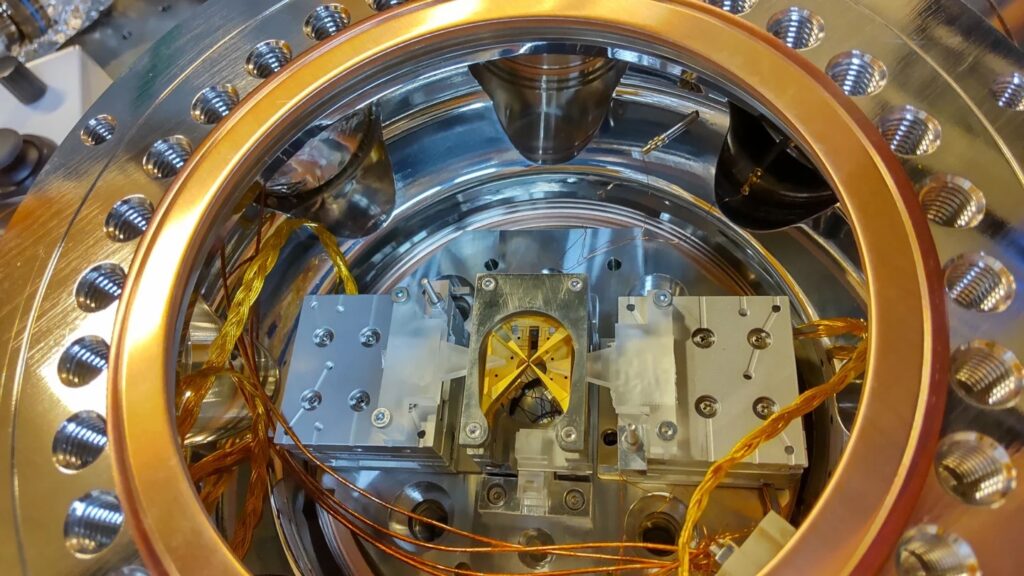
The ion-trap method confines ions — electrically charged atoms — within an electromagnetic field to perform computation. As noted above, quantum superposition is a foundational principle of quantum computing; however, a key engineering challenge lies in sustaining that superposition state for a meaningful duration.
Ion-trap quantum computers are distinguished by their ability to maintain superposition states for longer periods than competing approaches, as well as their low error rates. Their primary drawback is limited scalability: expanding qubit counts remains technically difficult.
To overcome this challenge, Qubitcore is developing methods to scale up individual qubits and to interconnect them for more complex computation. The work builds on research conducted by Hiroki Takahashi, Associate Professor at OIST and co-founder and Chief Strategy Officer (CSO) of Qubitcore.

12 Investors Participate
The seed round was led by SBI Investment, the venture capital arm of the SBI Group. A total of 12 investors participated, including corporate venture capital funds from prominent Japanese companies such as Yanmar Ventures and Daiwa House Ventures, as well as Bank of The Ryukyus, an Okinawa-based financial institution.
Proceeds will be directed toward accelerating research and development, cultivating joint research and proof-of-concept partners, and strengthening recruitment and organizational infrastructure.
Ryuta Watanuki, founder and CEO of Qubitcore, commented: “We are deeply honored to have received the support of SBI Investment and a diverse group of investors. Working alongside the R&D team led by CSO Hiroki Takahashi, we will accelerate our research and development, business development, and hiring — and build a quantum computing company from Japan that will underpin the world’s computational infrastructure.”