
Reading the full series? Browse all volumes here.
Before diving in — Vol. 2 sets out the author’s framing and caveats.
Many Japanese, when they hear the words “Ohmi Shonin,” picture a merchant shouldering a carrying pole. The figure looks something like the one in the photograph below.
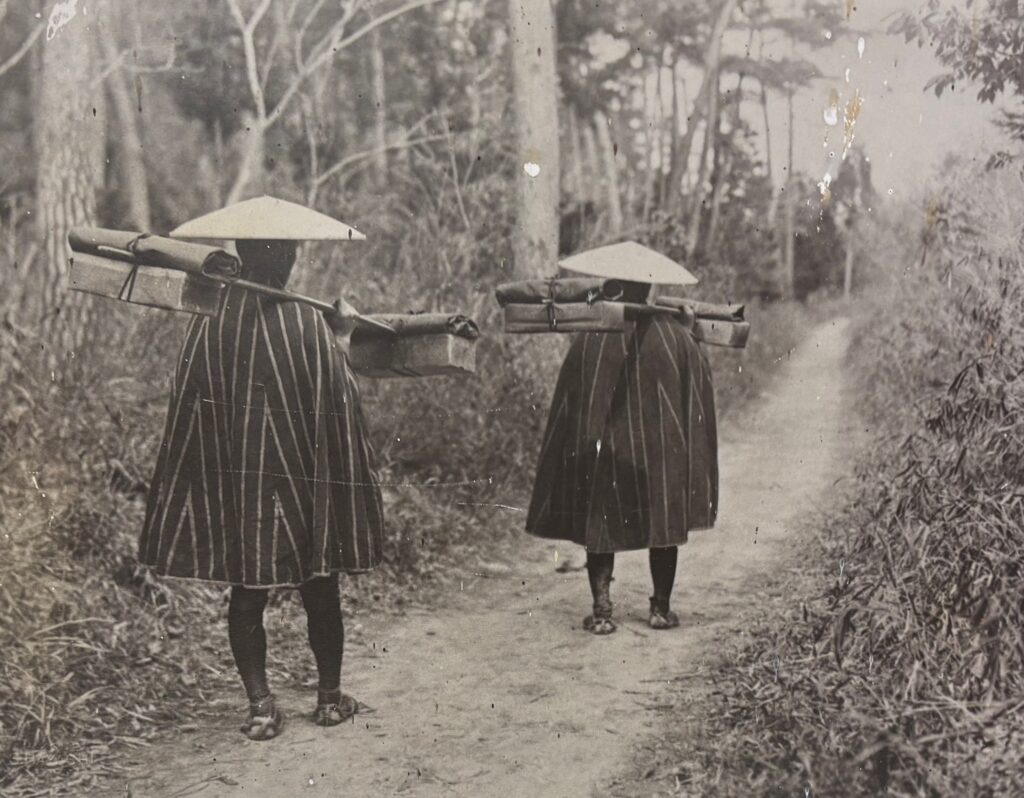
The photograph above was most likely taken in the closing years of the Edo period or the early Meiji era (1868–1912). As the modern age approached, railways and other transport networks were built out, and travelling on foot to peddle goods is thought to have grown less common.
The boxes lashed to both ends of the carrying pole in the photograph—wicker trunks called kōri—held the merchant’s wares along with the everyday necessities he used on the road. The braided sedge hat (amigasa) and travelling cloak (dōchū-gappa) worn in that same photograph are likewise part of the stock image of the Ohmi Shonin.
But not every Ohmi Shonin travelled dressed this way. Over this installment and the next, the focus is on how the Ohmi Shonin who were active in the Edo period—before Japan modernized—made their way out from Ohmi across the whole country.
Not Every Ohmi Shonin Shouldered a Carrying Pole
The picture of the Ohmi Shonin carrying their wares and personal effects in a kōri applies mainly to merchants who were still short of capital and had only just started out in business.*¹ It fits the era when Genzaemon Nakai began trading on a starting capital of two ryō.
There were no doubt also cases in which the employees (in today’s terms) of a larger merchant house set out for distant markets dressed the same way—but in those cases they did not necessarily shoulder the goods they meant to sell themselves. In the Edo period Japan had carriers known as hikyaku, and the shipping of merchandise was often left to them. Such employees, as well as merchants who had grown to a certain scale, travelled with samples of their goods and their personal effects packed into a kōri.*²
Ohmi Shonin: What Early-Modern Travel Was Really Like for Ordinary People
The Ohmi Shonin sometimes made use of horses, too.
This is something many Japanese, the author included, get wrong: there is a preconception that in Edo-period Japan only those of the samurai class could use horses. Yet if we step away from the matter of travel for a moment, plenty of Japanese are aware that on the farmland of the same era horses were used in place of today’s tractors.
Ordinary people in the Edo period, then, did use horses. The modern misconception likely stems from the fact that riding a horse was something restricted to upper-ranking samurai.*³ The author suspects that many people—himself among them—take the fact that commoners “could not ride” a horse and mistakenly read it as their being unable to “use” one at all.
To return to the main point: an Ohmi Shonin who had built up a degree of wealth would obtain a horse, load it with baggage—merchandise included—and head out on his peddling rounds.*⁴
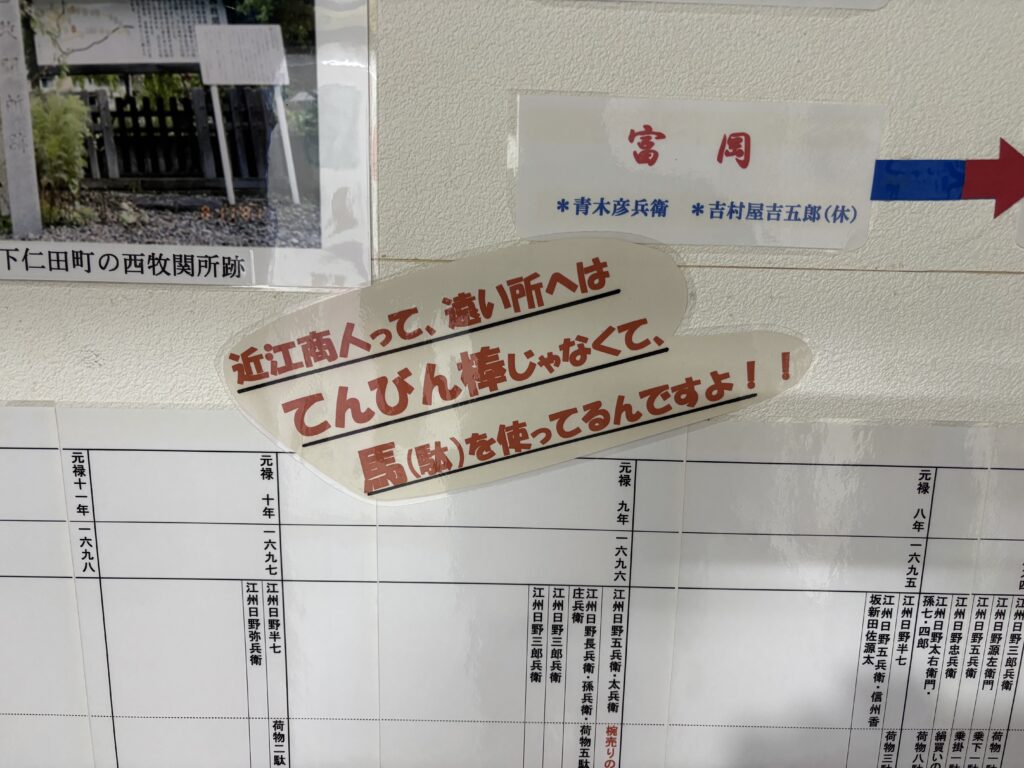
When a staff member at the Ohmi Shonin Kyōdokan in Higashiōmi explained this, the author asked, “Could the Edo-period Ohmi Shonin really use horses? Wasn’t their use restricted to the samurai?” The reply was that they are thought to have travelled leading the horses on foot.
OHYASHIMA is seeking information about the Ohmi Shonin
In connection with this series, OHYASHIMA welcomes information about the Ohmi Shonin. The author would be particularly grateful to hear from:
- Museum curators and archivists — in Japan or elsewhere — who hold collections related to the Ohmi Shonin
- Those who work for companies with ties to the Ohmi Shonin, or whose own ancestors were Ohmi Shonin
- Those who know of Ohmi Shonin merchants who conducted business outside Japan
OHYASHIMAは近江商人に関する情報を求めています
本連載にあたり、近江商人に関する情報を募集しています。たとえば、下記に該当する方はぜひご存じの情報をお寄せください。
- 日本国内外を問わず、近江商人に関する所蔵品がある博物館などの学芸員の方
- 近江商人と関連のある企業にお勤めの方、先祖などに近江商人がいらっしゃる方
- 日本国外でビジネスをした近江商人についてご存じの方
*¹ Ohmi Shonin-gaku Nyumon — CSR no Genryu ‘Sanpo Yoshi’ — Kaitei-ban, Kunitoshi Suenaga, Sunrise Publishing
*²“Shūun Kibun (Mōdo),” Hideki Usami, Mizkan Mizu no Bunka Center, Mizu no Bunka, No. 25
*³“The Lords, Samurai, and Animals of Fukuoka Domain: Horses and Hawks” (Fukuoka-han no Tonosama to Bushi to Dōbutsu-tachi: Uma to Taka), Fukuoka City Museum
*⁴ From exhibit materials at the Ohmi Hino Shonin-kan