
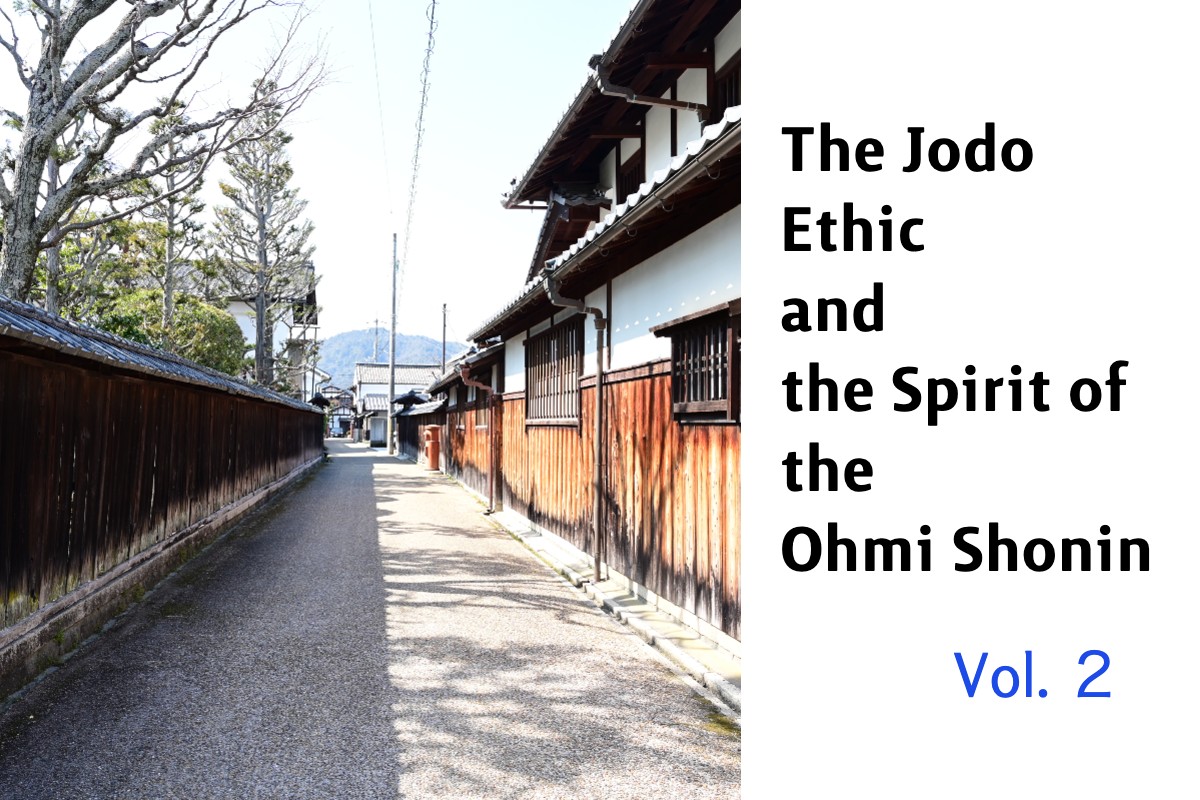
This series explores the ethos of the Ohmi Shonin — merchants whose spirit still resonates in today’s business world — and the ethics and philosophy of Jodo thought and Japanese religion that shaped them.
Before the series begins in earnest, this second installment offers readers a few notes the author wishes to set out in advance.
This series is not intended to glorify Japan or the Ohmi Shonin — nor, for that matter, to diminish them. As a Japanese person, the author naturally holds a deep affection for this country. At the same time, the author believes that business customs, social practices, and culture are each rooted in the particular land and conditions from which they emerge. However admirable the Ohmi Shonin’s management philosophy and methods may be, they cannot necessarily be exported abroad wholesale. The author hopes readers will find topics in this series worth drawing on — while recognizing that, just as naturally, not every reader will.
Readers will already have noticed that this series’ title plays on The Protestant Ethic and the Spirit of Capitalism. The author has no intention of arguing that Protestantism ≈ Jodo thought. The Ohmi Shonin were merchants born of a distinctly Japanese tradition of enterprise — yet that tradition differs from its Western counterpart. The author believes that phenomena parallel to those Max Weber described did exist in Japan, but does not hold that they were fundamentally the same thing. Weber’s Protestant Ethic and Spirit of Capitalism, and the Jodo thought and Ohmi Shonin that this series will explore, share certain qualities while remaining distinct. The author holds in equal respect Buddhism including Jodo thought, Christianity including Protestantism, Japan’s own tradition of enterprise, and the Western tradition of enterprise. It is also worth noting that this series will likely engage with more micro-level topics than The Protestant Ethic and the Spirit of Capitalism.
This series also examines the resonance between the ethical culture of the Ohmi Shonin’s upper strata and Jodo thought. It does not address the broader structures of social stratification in commerce — whether in the Ohmi region or across Japan more widely — during the early modern period. These are matters that continue to be subjects of scholarly and public debate in Japan today.
On the religious and philosophical side, some may take issue with treating Jodo-shu and Jodo Shinshu under the single umbrella of “Jodo thought.” The author has no intention of denying religious diversity. This series uses the term Jodo thought for the sake of clarity, with an eye especially toward readers outside Japan who may be less familiar with Japanese religious traditions — and asks for the understanding of those who find this framing objectionable. Of course, occasions to discuss Shinran’s Jodo Shinshu and Honen’s Jodo-shu individually and in some depth will certainly arise over the course of the series.
Finally, the Ohmi Shonin can be subdivided by region — into the Hachiman Shonin, the Hino Shonin, and others. As a rule, however, this series will not venture into that level of detail, simply because doing so would make the series harder to follow for readers outside Japan. There may be exceptions where a particular regional grouping warrants attention.