
Reading the full series? Browse all volumes here.
Before diving in — Vol. 2 sets out the author’s framing and caveats.
Any series on the Ohmi Shonin would be incomplete without addressing sanpo yoshi. Engaging with the business philosophy of the Ohmi Shonin also, the author believes, helps explain why this series exists in the first place.
So what, exactly, is sanpo yoshi?
At the most basic level, any commercial transaction requires at least two parties: a seller and a buyer. For a transaction to be repeated rather than one-off, it must benefit both sides. The “san” in sanpo yoshi means “three,” two of those three referring to the seller and the buyer both coming out ahead.
The Ohmi Shonin went further, holding that a transaction must benefit not only seller and buyer, but also “seken” — society at large. They aspired, in other words, to conduct business that served the world. Seller good, buyer good, society good: it was in serving all three that they believed a business derived its true value.
That, in essence, is sanpo yoshi.
No Ohmi Shonin Ever Explicitly Used the Term
There is, however, one important caveat. Not a single Ohmi Shonin — at least none known to have lived before the early Meiji era — ever wrote or said the words “seller good, buyer good, society good” or “sanpo yoshi” verbatim. Scholarly views on sanpo yoshi differ on many points, but on this one, researchers are in agreement.
Debate continues in academic circles over which historical source truly expresses the sanpo yoshi ideal, and whether various texts can rightly be called sanpo yoshi at all. That is not, however, the concern of this series. The aim here is to ask what the business methods left behind by the Ohmi Shonin can offer contemporary businesspeople — and so the author will not wade into those disputes.
Readers who wish to explore the scholarly debates further may consult — though it is in Japanese — the paper “Ohmi Shonin Studies and the Theory of Sanpo Yoshi” by Professor Emeritus Hideki Usami of the Faculty of Economics, Shiga University, which is freely available online.*¹ The paper takes issue with the prevailing account of how the term sanpo yoshi originated, but regardless of one’s own position, it provides a useful overview of how research into the Ohmi Shonin and sanpo yoshi has developed.
The Marubeni Executive Who Rebuilt an Elementary School in a Town of Under Ten Thousand
Even so, the fact that the Ohmi Shonin never used those exact words does not change the reality that they conducted business with an eye to the interests of every party — not merely their own. The historical record is clear on this point.
Among the clearest illustrations is the tradition of social contribution among the Ohmi Shonin.
One example: in 1818, Shojiemon Nakai — an Ohmi Shonin active in the mid-Edo period — funded and supplied materials for the reconstruction of Seta-no-Karahashi bridge. He also financed road construction and the building of stone lanterns along public thoroughfares.*²
Another figure who cannot be overlooked when discussing social contribution among the modern Ohmi Shonin is Tetsujiro Furukawa — nephew of the first Chubei Ito and the man who served as the de facto head of Marubeni Shoten, the forerunner of today’s Marubeni Corporation. Before turning to Furukawa’s story, however, the author must begin with the founding of Stanford University in the United States. The connection to Ohmi in Japan may seem puzzling at first — but bear with the author for a moment.
Stanford University is perhaps best known today for its location in what has come to be called Silicon Valley, and for the roster of entrepreneurs among its alumni — figures such as Peter Thiel and Elon Musk. Yet across its history, which spans more than a century from its founding in 1885, the university has produced a remarkable range of distinguished graduates, among them U.S. President Herbert Hoover and multiple Supreme Court justices.
The university bears the name of its founder, Leland Stanford — a man who amassed a fortune through railroads and other business ventures. When his only son died at the age of fifteen, Stanford channeled the greater part of his wealth into establishing a university in the boy’s memory. That institution became Stanford University.
More than forty years after Stanford’s founding, the brothers Tetsujiro and Gizo Furukawa paid it a visit. Learning the story of how the university had come to be, Gizo set down the following words:
“There is no shortage of people in this world who accumulate wealth — but few who dispose of it well. This seems especially true of the Japanese. Wealth is not something to be passed down forever within a single family or clan. Yet wealthy men in Japan insist on doing exactly that, only to produce foolish sons who, once their father dies after a lifetime of toil, squander everything he built as freely as water. Such men would do well to take a leaf from Mr. Stanford’s book when it comes to the disposition of their fortunes.”*³
A brief note on the Japanese phrase used here: the expression “tazanno ishi” (他山の石), rendered in this translation as “take a leaf from someone’s book,” literally refers to stones from another mountain — that is, something that at first appears unrelated but can be put to use. In its classical meaning, the phrase suggests learning from the mistakes of others rather than dismissing them as someone else’s problem. In contemporary Japanese, however, the expression is also used in the way Gizo seems to intend: taking a positive example from others as inspiration for one’s own conduct.
Returning to the story: inspired by Stanford’s example, Tetsujiro Furukawa also invested his personal fortune in education. He stopped short of founding a university, but he made a substantial donation toward the reconstruction of Toyosato Elementary School — the school he himself had attended and to which he was deeply attached.
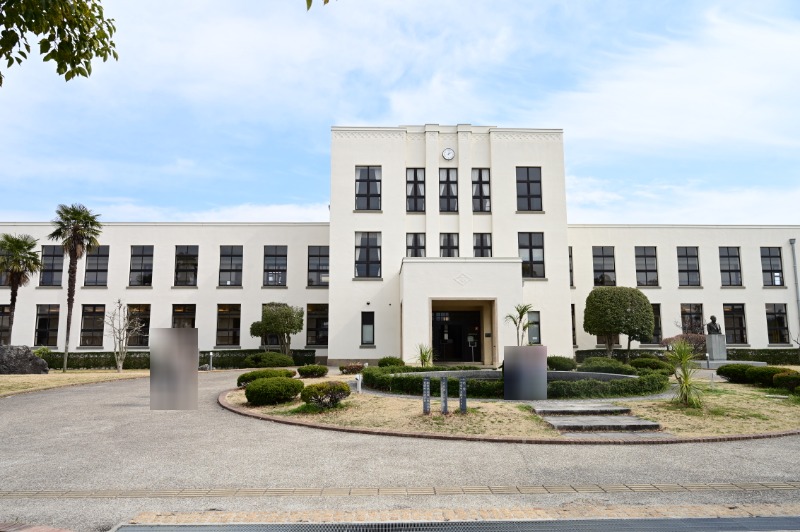
As noted in the caption above, the author visited the site in person. Frankly, it is a shame that a photograph alone cannot convey the dignity of this building. It is that impressive.
By way of digression: the author grew up not in Ohmi but in a Japanese city of an entirely different character — one with a population well above 100,000 — and attended an elementary school in the city center. The building had probably been constructed sometime around the middle of the Showa era and was, functionally, perfectly adequate.
And yet it cannot help but seem inferior when placed alongside the Toyosato Jinjo Elementary School building, rebuilt in 1937 — early Showa — with funds provided by Tetsujiro Furukawa.
Toyosato Town today has a total population of under ten thousand, and has seen little demographic change over the past four decades.*⁴ Even if the town had been somewhat larger at the time of the school’s reconstruction, it is hard to imagine it having reached 50,000 or 100,000 residents given Japan’s broader population trends — and had it done so, Toyosato would surely have been designated a city rather than a town.
The site is spacious, and the building struck the author as likely larger than the elementary school attended growing up. However small the town, every child deserves the finest possible environment — that, it seems, was the conviction that drove Tetsujiro Furukawa.
The total cost of constructing this building exceeded ten times Toyosato Town’s annual budget at the time.*⁵ Tetsujiro Furukawa, who provided the overwhelming majority of those funds, is said to have largely refrained from interfering with the architects — among them William Merrell Vories.*⁶
Vories himself is a figure the author will return to in a later installment of this series — he is known in Japan as “the blue-eyed Ohmi Shonin.”

Today, the building of Toyosato Elementary School is used each year for the orientation of Marubeni’s new recruits. During the author’s visit, the corridors displayed commemorative photographs of incoming employees from roughly the past decade.
Tetsujiro Furukawa was active in the first half of the twentieth century. His uncle, the first Chubei Ito, died in 1903 — meaning that by the time Tetsujiro came into his own, both Itochu and Marubeni had already taken shape as general trading companies.
One might assume, from this, that Tetsujiro and his brother Gizo had grown up in comfortable circumstances. In fact, the family’s financial situation led both brothers to abandon plans for higher education. On the other hand, having Chubei Ito — a formidable model of what a businessperson could be — close at hand, and being able to begin their careers under his guidance, was in all likelihood a stroke of fortune for Tetsujiro Furukawa.
OHYASHIMA is seeking information about the Ohmi Shonin
In connection with this series, OHYASHIMA welcomes information about the Ohmi Shonin. The author would be particularly grateful to hear from:
- Museum curators and archivists — in Japan or elsewhere — who hold collections related to the Ohmi Shonin
- Those who work for companies with ties to the Ohmi Shonin, or whose own ancestors were Ohmi Shonin
- Those who know of Ohmi Shonin merchants who conducted business outside Japan
OHYASHIMAは近江商人に関する情報を求めています
本連載にあたり、近江商人に関する情報を募集しています。たとえば、下記に該当する方はぜひご存じの情報をお寄せください。
- 日本国内外を問わず、近江商人に関する所蔵品がある博物館などの学芸員の方
- 近江商人と関連のある企業にお勤めの方、先祖などに近江商人がいらっしゃる方
- 日本国外でビジネスをした近江商人についてご存じの方
*¹ “Ohmi Shonin Studies and the Theory of Sanpo Yoshi,” Hideki Usami / Research Bulletin of the Institute of Economic Research, Faculty of Economics, Shiga University, No. 48
*² Kunitoshi Suenaga, Introduction to Ohmi Shonin Studies: “Sanpo Yoshi,” the Origins of CSR (Revised Edition) / Sunrise Publishing
*³ Gizo Furukawa (author), Hiroyasu Furukawa (publisher), Fuyokai (press), Sekai Hitonozoki-ki (Vol. 1)
*⁴ “Toyosato Town Population Vision: Town, People, and Jobs Creation,” Toyosato Town
*⁵ “Publication of Hiroyasu Furukawa’s ‘Tetsujiro Furukawa, Businessman of the Meiji, Taisho, and Showa Eras, and Toyosato Elementary School’,” Shiga Hikone Shimbun
*⁶ “Tetsujiro Furukawa: An Ohmi Shonin,” Marubeni Corporation