
Reading the full series? Browse all volumes here.

Before diving in — Vol. 2 sets out the author’s framing and caveats.

Up to this point, this series has focused mainly on the ethics and social contributions of the Ohmi Shonin. Yet some readers may be thinking: “I understand that they held admirable moral values. But did the Ohmi Shonin actually turn a proper profit?”
One piece of evidence that they did earn solid profits is the existence of Japanese companies that the Ohmi Shonin founded and that continue to this day. These firms have survived through to the present, even while living through hard times. Itochu Corporation, for example, founded by the first-generation Ohmi Shonin Chubei Ito, posted a net loss of as much as ¥88.2 billion (about $836 million at the exchange rate of the time) in its fiscal year ending March 2000. The reason it recorded such an enormous loss was that it disposed, all at once, of the non-performing assets created by the collapse of the bubble economy in the 1990s.

Other surviving companies that could be called “Ohmi Shonin enterprises” include Marubeni Corporation, founded—like Itochu—by the first-generation Chubei Ito; Nishikawa, known throughout Japan for its bedding under the name Futon no Nishikawa; and Takashimaya, today one of Japan’s leading department stores, which traces its origins to a shop opened in Kyoto by an adopted son of the Ohmi Shonin Gihei Iida.
Among Ohmi Shonin enterprises founded from the Meiji era onward—the period when Japan’s modernization advanced rapidly—one might also point to Nippon Life Insurance (Nissay), known worldwide as one of Japan’s largest institutional investors, and Wacoal, a major manufacturer of lingerie.
Genzaemon Nakai, Who Built a Fortune More Than 50,000 Times His Starting Capital
Conversely, there were of course merchant houses that went under. In his book,*¹ Kunitoshi Suenaga takes up eleven Ohmi Shonin families that once enjoyed great prosperity but later fell into ruin. In almost every case cited here, the pattern is one in which a successor indulged in dissipation and brought the house down. These, in other words, were Ohmi Shonin who had forgotten shimatsu shite kibaru—“to be frugal and to strive hard.”

So were there Ohmi Shonin who were not like that—who succeeded in business and put shimatsu shite kibaru into practice?
To state the conclusion first: yes, they certainly existed. Take a look at the photograph below.
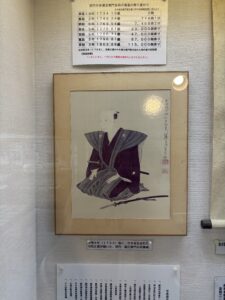
This is an exhibit at the Ohmi Hino Shonin-kan in Hino, Shiga Prefecture, and the work at its center is a portrait of Genzaemon Nakai. It was painted by Kohkan Shiba, an artist renowned in eighteenth- and nineteenth-century Japan. That Nakai placed great importance on shimatsu shite kibaru was discussed in Vol. 9.
What I would like you to notice is the table posted above the portrait, which explains how Nakai’s assets changed over time. In 1734, when Nakai was nineteen, his assets stood at 2 ryo. Converting Edo-period currency into present-day values is difficult, and one inevitably has to allow a fairly wide range, but it would come to roughly ¥100,000–¥200,000 ($600–$1,300).*²
Fifteen years later, at the age of thirty-four, the figure had become 774 ryo and 1 bu. Then in 1776, when Nakai was sixty-one, it had grown to a little over 23,000 ryo, and in his later years, at the age of eighty-eight (1803), he had built up an enormous fortune of 115,000 ryo. Reckoned against his starting capital, this means he amassed assets more than 50,000 times that amount.
The Double-Entry Bookkeeping of the Ohmi Shonin
Genzaemon Nakai began his career as a peddler of medicines. Being a peddler, he may well have gone out to sell his medicines carrying a balance pole on his shoulders, just like other Ohmi Shonin of his day. That was when he was nineteen, and as noted above his assets were 2 ryo—though he is said to have also carried 18 ryo in borrowings on top of that.
As his business prospered, Nakai branched out into such lines as sundries, rice, and pawnbroking. He also expanded aggressively into the Tohoku region, opening branch stores there.
Yukari Matsuda, currently an associate professor at Shiga University, published a paper in 2021 on the financial statements of the Nakai family’s branch stores.*³ According to this paper, in the accounts it drew up for 1802, the Nakai family’s Soma store (in present-day Soma City, Fukushima Prefecture) generated a net profit of 172 ryo.
Of course, in any single year—and at the level of an individual branch—there would have been years of profit and years of loss. Even so, considering that Genzaemon Nakai’s assets had swelled to 115,000 ryo by 1803, it seems fair to conclude that, over the long run, the business was steadily turning a profit.
The Nakai family did not merely run a business and make money. They also adopted something close to modern double-entry bookkeeping. In the Nakai family’s case, on the sales floor a clerk would enter records of transactions in a “sales ledger” (uriage-cho).*⁴ Then, at a place within the store called the kekkai, a cashier would manage the money using a “cash ledger” (kingin-deiri-cho). And after business had closed for the day, the sales ledger and the cash ledger were checked against each other. This reconciliation work was called choai.
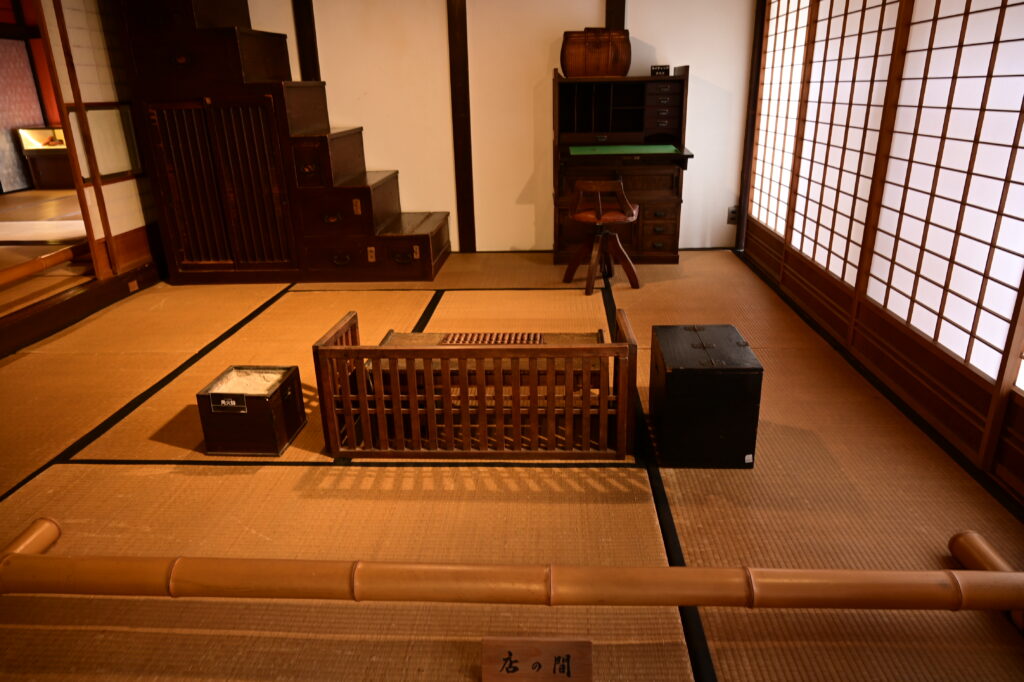
In other words, while turning a profit, they also kept as data a record of exactly how much that profit was, and of how much profit each store made in each year.
The Ohmi Shonin other than the Nakai family also kept their books by methods resembling double-entry bookkeeping, each in their own way. That said, according to the paper by Matsuda cited above, each merchant house treated such bookkeeping methods as secrets never to be disclosed outside the family. Moreover, even within the same merchant house, the way the books were kept could differ from store to store and from department to department. As such, it was not the kind of system—unlike modern double-entry bookkeeping—in which anyone with the requisite knowledge could tell how much profit or loss, or how many assets or borrowings, there were.
Yet the so-called Western double-entry bookkeeping that grew out of the world of The Merchant of Venice did not reach Japan until 1873.*⁵ That the Ohmi Shonin had produced something close to double-entry bookkeeping at least seventy years before that is, in this author’s view, a reflection of the seriousness with which they approached their business.
OHYASHIMA is seeking information about the Ohmi Shonin
In connection with this series, OHYASHIMA welcomes information about the Ohmi Shonin. The author would be particularly grateful to hear from:
- Museum curators and archivists — in Japan or elsewhere — who hold collections related to the Ohmi Shonin
- Those who work for companies with ties to the Ohmi Shonin, or whose own ancestors were Ohmi Shonin
- Those who know of Ohmi Shonin merchants who conducted business outside Japan
OHYASHIMAは近江商人に関する情報を求めています
本連載にあたり、近江商人に関する情報を募集しています。たとえば、下記に該当する方はぜひご存じの情報をお寄せください。
- 日本国内外を問わず、近江商人に関する所蔵品がある博物館などの学芸員の方
- 近江商人と関連のある企業にお勤めの方、先祖などに近江商人がいらっしゃる方
- 日本国外でビジネスをした近江商人についてご存じの方
*¹ Ohmi Shonin-gaku Nyumon — CSR no Genryu ‘Sanpo Yoshi’ — Kaitei-ban, Kunitoshi Suenaga, Sunrise Publishing
*² Reference case: “What would 1 ryo from around the Kan’ei era be worth today?” National Diet Library, Collaborative Reference Database
*³ “A Study of Bookkeeping Practices in Merchant Houses in the Late Edo Period: From an Analysis of the Tana-oroshi Mokuroku of the Ohmi Shonin Nakai Family,” Yukari Matsuda
*⁴ From exhibit materials at the Ohmi Hino Shonin-kan
*⁵ “The History of Double-Entry Bookkeeping,” freee