
Reading the full series? Browse all volumes here.
Before diving in — Vol. 2 sets out the author’s framing and caveats.
Vol. 7 noted that the Ohmi Shonin did not conduct business in Ohmi itself; rather, they used Ohmi as a base from which to peddle goods across the whole of Japan.
It is perhaps precisely because they sought business opportunities wherever they could find them, rather than confining themselves to a fixed territory, that so many companies with roots in the Ohmi Shonin — Itochu Corporation, Marubeni Corporation and Nishikawa, among others — survive to this day.
The Ohmi Shonin of the Edo period (17th–19th centuries) did not merely peddle goods; they also, at times, established bases across Japan. Three methods can be identified by which the Ohmi Shonin expanded across the country:
- Peddling
- Branch shops and sub-branches
- Joint-stock trading
The Hino Ohmi Shonin, Who Built a Network Across What Is Now the Tokyo–Nagoya–Osaka Corridor
Of the three methods above, peddling has come up repeatedly in this series.
An independent Ohmi Shonin would first tie a wicker case to a carrying pole, pack it with his belongings and merchandise, and set off to peddle goods from place to place. Once he had built up a certain track record, he would travel alone from place to place, while his goods were transported by courier, by shipping agent, or by boat.
Last time, alongside the above, the author touched on how the Ohmi Shonin used shipping agents in the Hokuriku region to trade with Hokkaido.
There, the author explained that peddlers formed what he called joint ventures, pooling resources to transport goods and to strengthen their bargaining position with shipping agents. “Joint venture” may, however, have been something of an overstatement. Kunitoshi Suenaga, a scholar of the Ohmi Shonin, describes these merchant alliances instead as “peddling associations”.¹
Specifically, the peddling association that made use of shipping agents in Hokuriku was a group of merchants from the eastern shore of Lake Biwa who called themselves the “Ryohama-gumi”.
Merchants based in what is now the city of Ohmihachiman, meanwhile, formed a peddling association called the “Ebisu-ko”, which cooperated on sales activities in the Tohoku region. There were other cases, too, of merchants forming a “ko”according to their sales territory.
And the association that Suenaga, cited above, rates as the largest of all the Ohmi Shonin’s peddling associations is the “Hino Daitoban Nakama”.
The author, too, saw an exhibit on the Hino Daitoban Nakama at the Ohmi Hino Shonin Museum, and it certainly gave a clear sense of merchants building a network to do business across the area stretching from Ohmi’s home region of Kansai into the Kanto region. The photograph below shows where the inns the Hino Daitoban Nakama used as their regular lodgings were located. To readers outside Japan, it may be hard to make sense of all the lines and kanji characters — but it is, in short, a map.
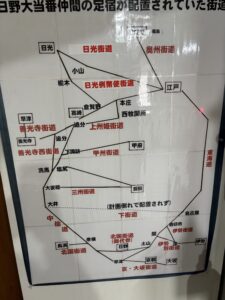
At the bottom right are two characters enclosed in boxes: these are Kyoto and Osaka. Slightly above them, in the middle, is another boxed character — Hino. The long line to its right is the Tokaido, and the line to its left is the Nakasendo. Some readers may recognise the Tokaido as the name of a Shinkansen line. In the Edo period, the Tokaido was the name of the road linking Edo and Kyoto, running along the Pacific coastline. The Nakasendo, meanwhile, was the inland road that likewise connected Edo and Kyoto. Higher up there is a character obscured by glare; this is Sukagawa, a town in what is now Fukushima Prefecture. The box to its left is Nikko, a UNESCO World Heritage Site that some readers may have visited. And the box below, connected to Sukagawa by a line, is Edo — present-day Tokyo.
There is a term for what are arguably the three largest metropolitan areas in present-day Japan: “Tomeihan”. “To” stands for Tokyo, “mei” for Nagoya (the Sino-Japanese reading of the character for Nagoya’s “na” is “mei”), and “han” for Osaka (the Sino-Japanese reading of the character for Osaka’s “han” is likewise “han”). This means that the merchant association the Hino Daitoban Nakama covered, in business terms, what is now the Tomeihan corridor. That was possible not simply because they kept regular inns, but because each area had merchants who handled retail sales, as well as ordinary consumer customers.
The Ohmi Hino Shonin Museum even displays the specific names of the inns in each post town. A post town is a town with lodgings lining a highway. The photograph below is one such example.
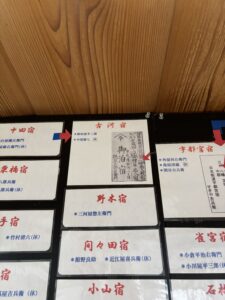
The top panel lists two regular inns the Hino Daitoban Nakama kept in the post town of Koga. Koga lay on the Nikko Kaido, the road linking Edo and Nikko, and was also a castle town.
It may sound like boasting, but the author’s grandfather served as mayor of this very Koga. He held the post for three terms over twelve years in total: from 1983 to 1991, and again from 1995 to 1999.
The author recently visited Koga for a memorial service for his grandparents (he may explain Japanese Buddhist memorial services in more detail in a future instalment on Buddhism in Japan), and while walking from the station to the family temple, crossed the former Nikko Kaido, along which the old inns would once have stood. The panel above lists the names of inns in the Koga post town as “Nomuraya Hanzaburo” and “Nakaya Genshichi”. However, the author could not identify any lodging currently operating in Koga under the names “Nomuraya” or “Nakaya”.
Even so, the reporting trip to the Ohmi Hino Shonin Museum left the author with a sense of a small connection to the Ohmi Shonin, and his recent visit to Koga, too, set him thinking of the Ohmi Shonin who once peddled their wares there, on foot and on horseback, long ago.
OHYASHIMA is seeking information about the Ohmi Shonin
In connection with this series, OHYASHIMA welcomes information about the Ohmi Shonin. The author would be particularly grateful to hear from:
- Museum curators and archivists — in Japan or elsewhere — who hold collections related to the Ohmi Shonin
- Those who work for companies with ties to the Ohmi Shonin, or whose own ancestors were Ohmi Shonin
- Those who know of Ohmi Shonin merchants who conducted business outside Japan
OHYASHIMAは近江商人に関する情報を求めています
本連載にあたり、近江商人に関する情報を募集しています。たとえば、下記に該当する方はぜひご存じの情報をお寄せください。
- 日本国内外を問わず、近江商人に関する所蔵品がある博物館などの学芸員の方
- 近江商人と関連のある企業にお勤めの方、先祖などに近江商人がいらっしゃる方
- 日本国外でビジネスをした近江商人についてご存じの方
*¹ Ohmi Shonin-gaku Nyumon — CSR no Genryu ‘Sanpo Yoshi’ — Kaitei-ban, Kunitoshi Suenaga, Sunrise Publishing