
Reading the full series? Browse all volumes here.
Before diving in — Vol. 2 sets out the author’s framing and caveats.
After arriving in the eastern provinces, known as Togoku, Shinran first established a base at a place called Shimotsuma in Hitachi Province, and later moved it to Kasama, also in Hitachi.
The support Shinran won in the eastern provinces
The author is from Ibaraki Prefecture, which was once Hitachi Province. Shimotsuma in particular is somewhat familiar, as the author used to pass through it on the way to his grandparents’ house in Koga. (Koga is now part of Ibaraki, but it formerly belonged to Shimousa Province rather than Hitachi. Apart from Koga and a few other areas, most of the former Shimousa Province now lies in Chiba Prefecture.) In addition, the junior high and high schools the author attended were private schools that drew students from many places regardless of school districts, and some of his classmates came from Shimotsuma.

Kasama is less familiar to the author than Shimotsuma, but pottery has flourished there since the 18th century, and its ware, known as Kasama-yaki, is fairly well known within Japan. While writing this, the author was also reminded that Kasama is home to the Kasama Nichido Museum of Art, which he has long meant to visit. The museum holds works by Japanese-born artists such as Léonard Foujita, as well as by artists from abroad such as Vincent van Gogh and Pablo Picasso.
But let us return to Shinran.
Although Shinran was based in Shimotsuma and Kasama, he travelled within a radius of 30–40 kilometres (approximately 19–25 miles) of these places to spread his teaching.*¹ This means that he also preached in present-day Tochigi Prefecture and other areas adjoining what is now Ibaraki. Disciples who received the teaching directly from Shinran are recorded in these places.
Those who became his disciples, or disciples of his disciples, came from a wide range of backgrounds: samurai, farmers, fishermen and Shonin (merchants), among others. It is said, however, that samurai and fishermen were particularly moved by Shinran’s teaching.
This is because they found salvation in Shinran’s teaching of Akunin Shoki — the idea that it is precisely the “evil person” whom Amida Buddha above all seeks to save. As noted in Vol. 27, the Buddhist precepts forbid the taking of life. Yet a samurai’s very reason for existence was to fight, and if he spared an enemy in battle, he risked the death of himself, his family, his lord, his retainers or other comrades.
Fishermen, too, took life, since they made their living by catching fish and selling them. Moreover, in the 13th century, when Shinran lived in the eastern provinces — that is, the Kanto region — the area is thought to have had far more extensive bodies of water than today. Even in central Tokyo, where people now live, many places were once under water.*² It is therefore likely that there were a fair number of fishermen in the places Shinran visited to preach.
In Buddhist terms, such people became “evil” because they took life. That is why they found reassurance in Shinran’s teaching that it is the evil who are saved, and saved through the nenbutsu, the recitation of Amida Buddha’s name — and why they put their faith in him.
In this way, Shinran’s missionary work from his base in Hitachi Province achieved a measure of success. Jodo Shinshu became an independent school only after Shinran’s lifetime, but his preaching in the eastern provinces can be said, at least in part, to have laid the foundations for the school’s prosperity today.
Today, however, there are relatively few Jodo Shinshu temples in the Kanto region.*³ The author will go into this in detail in another instalment, but one theory holds that it is related to Ieyasu Tokugawa’s fear of the power of the Honganji. At the same time, Japanese Buddhist temples of the past were — at the risk of being misunderstood — somewhat lacking in principle, and sometimes switched the school to which they belonged.*⁴ It is therefore conceivable that some temples originally founded under Shinran’s teaching became temples of other schools over the course of their long histories.
A colossal Buddha erected in the late 20th century on land where Shinran preached
This instalment may read a little like a travel guide, but the author would like to introduce one more striking site connected with Jodo Shinshu in the Kanto region: the Ushiku Daibutsu, the Great Buddha of Ushiku.
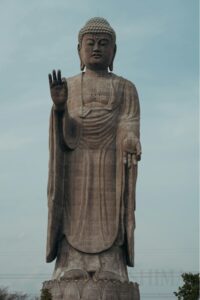
The statue stands 120 metres tall including its pedestal, and is listed in the Guinness Book of Records as the world’s tallest bronze statue.*⁵ It was completed in 1992 — that is, at the end of the 20th century — making it a relatively recent creation.
The statue was erected by the Higashi Honganji-ha, a branch of Jodo Shinshu. This series has already mentioned several times that the Honganji, the head temple of Jodo Shinshu, was once split into eastern and western branches, and the author intends to discuss the details in a future instalment. The Higashi Honganji-ha was formed in 1981 when it broke away from the Shinshu Otani-ha (whose head temple in Kyoto is commonly known as Higashi Honganji, although its official name is Shinshu Honbyo).*⁶ The split stemmed from differing views on governance within the school. Incidentally, the head temple of the Higashi Honganji-ha, also called Higashi Honganji, is located in Asakusa, Tokyo.
The author once interviewed staff at the Ushiku Daibutsu by telephone.*⁷ On that occasion, its public relations officer explained the reason for its construction as follows:
“The temple of the Ushiku Daibutsu belongs to Jodo Shinshu. Its founder, the Venerable Shinran, spent 20 years here in Ibaraki Prefecture (Hitachi Province), where he wrote the school’s fundamental scripture, the Kyogyoshinsho [The Teaching, Practice, Faith and Realisation]. It would be no exaggeration to say that Jodo Shinshu was born in Ibaraki — this is a place deeply connected with the Venerable Shinran.”
This is no doubt one of the reasons, but the Ushiku Daibutsu also has a large cemetery attached to it. Perhaps Ushiku was chosen as a place, relatively close to Tokyo, where a large number of burial plots could be sold.
The author is by no means criticising the Higashi Honganji-ha; on the contrary, he believes that a certain amount of money is necessary to sustain a religion. Of course, it is also important that the sums involved are not a burden on any individual believer or anyone else concerned. The author will return to this point in a later instalment.
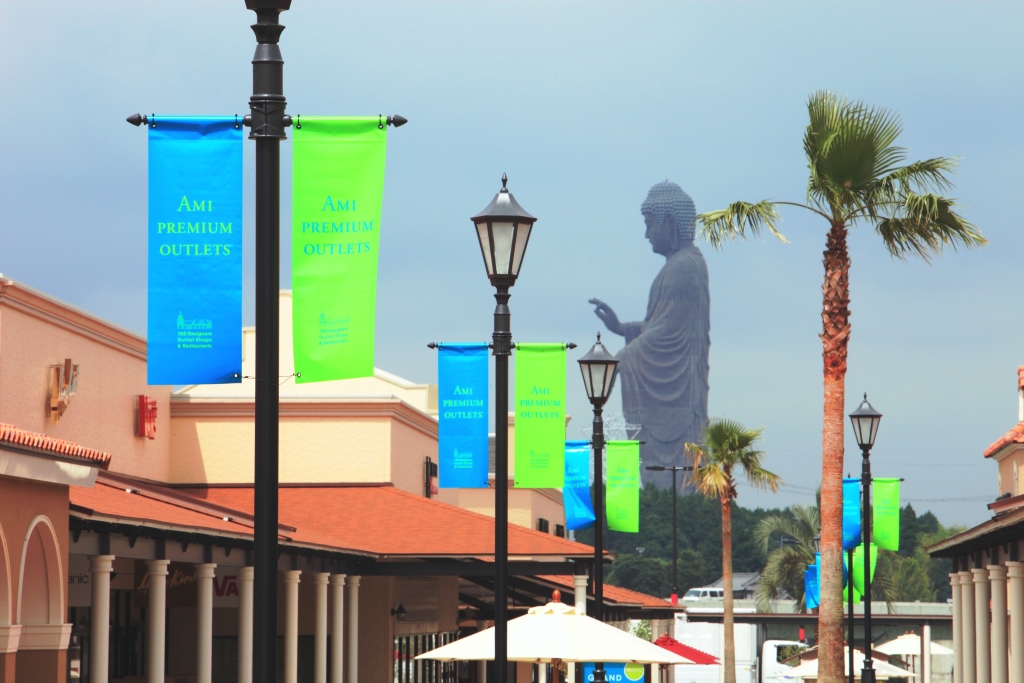
It must be about ten years since the author last visited the Ushiku Daibutsu. On a trip to the nearby outlet mall, Ami Premium Outlets, his wife caught sight of the enormous statue and said she wanted to see it, so they went. The author remembers a group of tourists, probably from Thailand, who were likewise astonished by its size. It struck him that, for a Northeast Asian who follows Mahayana Buddhism such as the author and for Southeast Asians who follow Theravada Buddhism alike, a great Buddha is a shared symbol.
As mentioned, the outlet mall is close by, so visitors can combine shopping with a visit to the Ushiku Daibutsu (indeed, the statue is clearly visible from Ami Premium Outlets). Without a car, however, it may be a little inconvenient to reach. Using public transport alone means taking a local bus from Ushiku Station on the JR Joban Line, which starts in central Tokyo. Buses are also infrequent on weekdays, so those who feel uneasy about taking a local bus, not least because of the language barrier, may prefer a taxi, though it costs a little more.
OHYASHIMA is seeking information about the Ohmi Shonin
In connection with this series, OHYASHIMA welcomes information about the Ohmi Shonin. The author would be particularly grateful to hear from:
- Museum curators and archivists — in Japan or elsewhere — who hold collections related to the Ohmi Shonin
- Those who work for companies with ties to the Ohmi Shonin, or whose own ancestors were Ohmi Shonin
- Those who know of Ohmi Shonin merchants who conducted business outside Japan
OHYASHIMAは近江商人に関する情報を求めています
本連載にあたり、近江商人に関する情報を募集しています。たとえば、下記に該当する方はぜひご存じの情報をお寄せください。
- 日本国内外を問わず、近江商人に関する所蔵品がある博物館などの学芸員の方
- 近江商人と関連のある企業にお勤めの方、先祖などに近江商人がいらっしゃる方
- 日本国外でビジネスをした近江商人についてご存じの方
*¹ What Is Jodo Shinshu? Shinran’s Teaching and Its Lineage, Satoko Koyama, Chuko Shinsho
*²What River and Plain Landforms Reveal: The Case of the Lower Tone and Arakawa Lowlands, Sumiko Kubo
*³Temple Guide, Rensho-ji Temple, Jodo Shinshu Hongwanji-ha (Nishi Hongwanji)
*⁴ Why Is Jodo Shinshu the Largest School in Japan? The Riddle of Buddhist Schools, Hiromi Shimada, Gentosha Shinsho
*⁵Ushiku Amida Daibutsu, Ushiku Daibutsu
*⁶About Higashi Honganji, Higashi Honganji, Head Temple of the Jodo Shinshu Higashi Honganji-ha
*⁷Calls to “Build a Great Buddha!” after a Spate of Disasters: Is It Really That Easy to Build One?, Michi Tohma, Shupure News (Weekly Playboy News)