
Reading the full series? Browse all volumes here.
Before diving in — Vol. 2 sets out the author’s framing and caveats.
As “Sanpo Yoshi I” and “Sanpo Yoshi II” explored, the Ohmi Shonin placed great emphasis on doing business in ways that benefited themselves, their trading partners, and society at large.
But it was also about creating conditions in which the merchants themselves could do business more easily.
To explore this, it helps to first understand how the Ohmi Shonin actually conducted their trade.
Merchants who traded far from home: the Ohmi Shonin
OhmiOhmi is the old name for the area that corresponds to present-day Shiga Prefecture.
Not every merchant who did business in Ohmi was considered an Ohmi Shonin. The term generally refers to merchants who engaged in what was known as mochi-kudari trade: carrying goods from Ohmi and the Kamigata region — meaning Kyoto and Osaka — to provincial destinations and selling them there. The reverse practice, whereby merchants returning from the provinces acquired local products and sold them back in Ohmi or Kamigata, was called mochi-agari.*¹
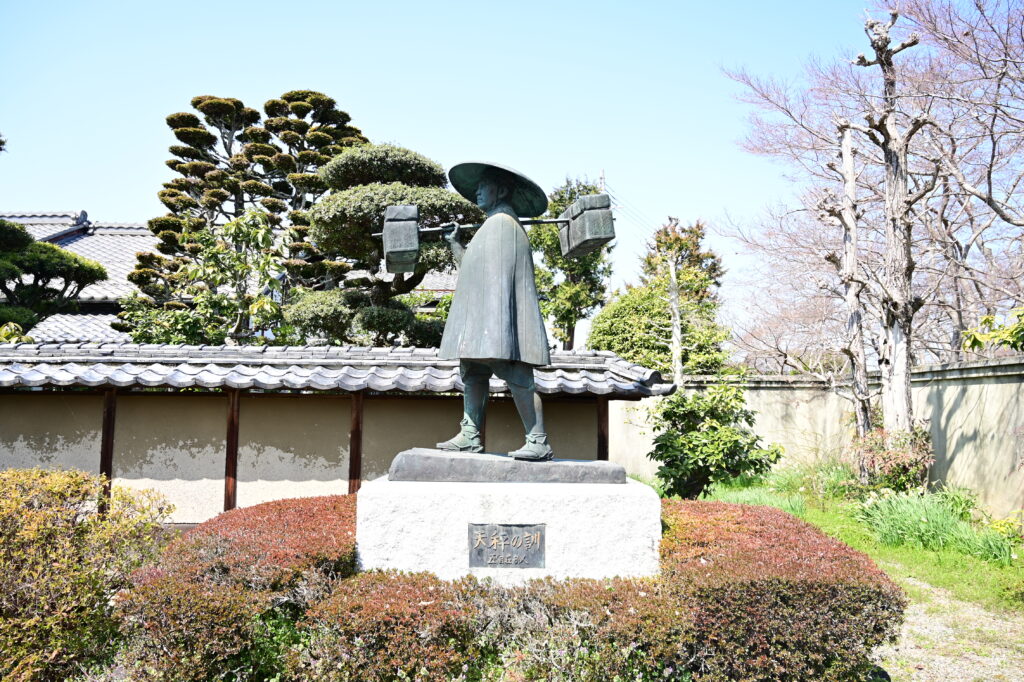
Because the Ohmi Shonin went back and forth between these two modes of trade, their method was also known as nokogiri commerce — after the saw (nokogiri), whose teeth cut in both directions.
In short, the Ohmi Shonin conducted most of their business not within Ohmi itself but in distant regions. As their operations grew, some also opened permanent storefronts in those faraway places.
The Ohmi Shonin thus operated, in most cases, as outsiders. On this point, Kunitoshi Suenaga, professor emeritus at Doshisha University and one of the foremost scholars of the Ohmi Shonin, has observed that this outsider consciousness “led to a style of management that involved thinking on a daily basis about how to coexist with local communities and show consideration for the regions where they traded.”*²
As outsiders, they could not afford to be disliked by the people of the places where they traded. Maintaining strict conduct, avoiding the pursuit of excessive profit, and striving to be welcomed by local communities: these were part of the Ohmi Shonin’s practical wisdom.
The injunction against excessive profit is one that Jihei-sogan Nakamura, an Ohmi Shonin, set out in a letter to his adopted heir. Suenaga takes the position that this letter is the original source of the Sanpo Yoshi ideal.
Suenaga further explains that Nakamura urged deep devotion to the gods and buddhas as a means of keeping in check the desire for high profits. Such strong religious faith was not unique to Nakamura: it was a trait shared by many Ohmi Shonin, including Chubei Ito.
The author suspects there may be additional factors behind the Ohmi Shonin’s strong religious faith — but with reporting and research still underway, this remains a hypothesis. The author hopes to return to the question once the fieldwork is complete.
On the humility that likely lay at the heart of the Ohmi Shonin
The author writes this series in the hope that the methods of the Ohmi Shonin may prove useful to readers in their own business lives.
That said, putting all of Sanpo Yoshi into practice may not be easy for readers outside Japan.
To be clear, this is not because the Ohmi Shonin or Japanese businesspeople are somehow superior. Different countries produce businesspeople who excel in different areas, just as individuals have different strengths. And the author would warmly encourage readers outside Japan who feel an affinity with Sanpo Yoshi to explore it further. (From the next instalment onwards, the series will move into the specifics of each of the three principles.)
The reason the author thinks some aspects may be challenging for readers outside Japan comes down to a distinctly Japanese disposition and custom: kenkyo — humility.
Kenkyo means conducting oneself with modesty and restraint. A humble manner makes it easier for others to accept a person — and in some cases, that humility may ultimately work to the humble person’s own advantage.
The Ohmi Shonin’s Kai-te Yoshi and Seken Yoshi — good for the buyer, good for society — may likewise be understood as an intention to ensure that both parties benefit, with humility serving as one of the means.
Similar ideas exist in many cultures, of course. But Japanese has an unusually rich cluster of words in this space — beyond kenkyo itself, there is kenson (modesty, self-deprecation) and kenjo (deference, yielding to others), among others. This suggests to the author that the idea of deferring to others while keeping things running smoothly may be, in a global context, somewhat distinctive.
The point the author is making is this: if humility feels like a barrier when trying to put Sanpo Yoshi into practice, it may be perfectly fine to set that particular element aside for now. Character is hard to change, and humility is not something one acquires overnight. But even without changing one’s character, it is easier to change how one thinks and acts. For instance, if working out the right level of profit for Kai-te Yoshi feels overwhelming, one alternative might be to focus instead on Uri-te Yoshi — good for the seller — and think about how to give more back to one’s own employees. Or there is always the option of finding some form of social engagement through the lens of Seken Yoshi.
One more thing. Being Japanese does not mean being humble — not everyone is. And there are plenty of Japanese businesspeople who succeed not through humility but through other excellent qualities. Conversely, among foreigners who have spent a long time in Japan, some come across as more humble than many Japanese people.
So for readers who find Sanpo Yoshi daunting, the author’s message is simply this: there is no need to feel you must take all of it on board.
OHYASHIMA is seeking information about the Ohmi Shonin
In connection with this series, OHYASHIMA welcomes information about the Ohmi Shonin. The author would be particularly grateful to hear from:
- Museum curators and archivists — in Japan or elsewhere — who hold collections related to the Ohmi Shonin
- Those who work for companies with ties to the Ohmi Shonin, or whose own ancestors were Ohmi Shonin
- Those who know of Ohmi Shonin merchants who conducted business outside Japan
OHYASHIMAは近江商人に関する情報を求めています
本連載にあたり、近江商人に関する情報を募集しています。たとえば、下記に該当する方はぜひご存じの情報をお寄せください。
- 日本国内外を問わず、近江商人に関する所蔵品がある博物館などの学芸員の方
- 近江商人と関連のある企業にお勤めの方、先祖などに近江商人がいらっしゃる方
- 日本国外でビジネスをした近江商人についてご存じの方
*¹Koho Hino, 1 Apr. 2012, Hino Town
*² Ohmi Shonin-gaku Nyumon: CSR no Genryu “Sanpo Yoshi,” Kunitoshi Suenaga, Sunrise Publishing