
Reading the full series? Browse all volumes here.
Before diving in — Vol. 2 sets out the author’s framing and caveats.
Why did the Ohmi Shonin command such a formidable commercial presence across the whole of Japan from the Edo period (the 17th to 19th centuries)? The previous volume set out three methods by which they achieved this:
- Peddling
- Branch shops and sub-branches
- Joint-stock trading
The first of these, peddling, was the Ohmi Shonin’s most basic technique. The previous volume looked at the peddling associations through which even a lone merchant could carry it out in a more organised way.
This time, the author turns to the second: branch shops and sub-branches. That English rendering, however, risks feeling slightly inaccurate, so the discussion will keep to the original Japanese terms — demise and edamise — throughout.
A note for readers of English: demise here is simply the romanisation of a Japanese word meaning a branch store. It happens to be spelled exactly like the English word “demise” — death, or downfall — but the two are wholly unrelated.
Why demise and edamise clustered in eastern rather than western Japan
As the renderings above suggest, demise can be translated as branch shops, or a branch office, and edamise as sub-branches — a sales office, a field office, or a representative office. The headquarters, meanwhile, the Edo-period Ohmi Shonin called the honke: in the language of modern business, the main store or head office.
According to Kunitoshi Suenaga,*¹ the demise and edamise of the Ohmi Shonin reached, in the Edo period, from Hokkaido in the north to Kagoshima in the south — covering, in other words, almost the whole country. In Hokkaido’s case, however, as discussed in Vol. 10, the authority of the Tokugawa shogunate extended only to the Matsumae domain, in what is today the Donan region of southern Hokkaido.
Suenaga adds that the Ohmi Shonin’s demise and edamise were “especially densely distributed across eastern Japan, from Tohoku through to the Kanto region.” The reason, he suggests, is that western Japan had many powerful daimyo and tighter regulation, whereas eastern Japan had more small-scale daimyo, making the east the easier place for merchants to do business. His book, written for readers with a fair grounding in Japanese history, leaves the point there; for readers outside Japan, a fuller explanation is in order.
The Tokugawa shogunate (the Edo shogunate) was established when the army led by Ieyasu Tokugawa prevailed at the Battle of Sekigahara in 1600. It was a feudal order: the head Tokugawa house in Edo stood at the centre, while daimyo — the shogun’s vassals — governed the provinces. Among them, houses related to the Tokugawa by blood were called shinpan daimyo; those that had served the Tokugawa since before Sekigahara, fudai daimyo; and those that became vassals only after the battle, tozama daimyo.
Accordingly, shinpan and fudai daimyo were often placed near Edo, the shogun’s seat, while tozama daimyo were frequently posted to remote regions to guard against rebellion. In some cases, shinpan or fudai were stationed expressly to keep watch over the tozama.
That is not to say the tozama were weak. On the contrary — having contended with the Tokugawa right up to Sekigahara, it was not unusual for a tozama house to surpass the fudai in military or economic strength. The prime examples are the Shimazu of Satsuma (present-day Kagoshima Prefecture)*² and the Mori of Choshu (present-day Yamaguchi Prefecture),*³ the very houses that would later bring down the Tokugawa shogunate.
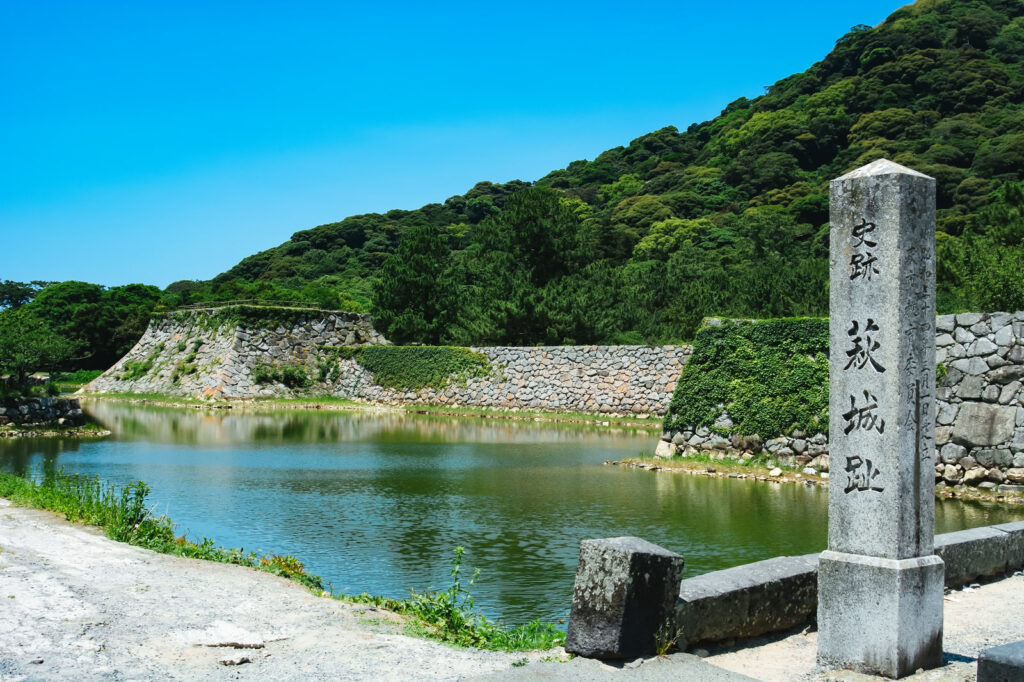
The lands governed by tozama houses such as the Shimazu and Mori lay squarely in western Japan. The author, for his part, comes from the town of Tsuchiura in the Kanto region; in the Edo period the Tsuchiura domain was held by the Tsuchiya, a fudai house. Koga, which featured in the previous volume, is likewise in Kanto, and was held by the Doi, another fudai house. Going into kokudaka — assessed rice yield — in detail would only complicate matters, but taking it as a proxy for economic output, the Shimazu and Mori commanded several to ten times the strength of the Tsuchiya and Doi.
The point is that the daimyo of western Japan, in order to preserve their power, tended to impose various regulations, whereas those of eastern Japan sometimes lacked the strength to regulate so tightly. It was against this backdrop that the Ohmi Shonin came to establish so many of their demise and edamise across eastern Japan.
“Set up shop where, for three ri around, people eat rice from the pot”
Widely though the Ohmi Shonin spread their demise and edamise across Japan, they did not, of course, open shops indiscriminately.
One saying that captures the standard by which they chose their sites runs: “Set up shop where, for three ri around, people eat rice from the pot.” Three ri is about 12 kilometres (some 7.5 miles), and “around” — literally “on all four sides” — means in every direction. “Where people eat rice from the pot” can be read as a place with households in which people cook: that is, where consumers are, and, put differently, where there is demand.
So the saying can be read as: take the shop as your reference point, set a trading area of roughly 12 kilometres around it, and there must be demand within it.
Here, the reader is invited to look at a Google map that conveys the topography of Japan.
It has been zoomed in on Honshu to make the terrain easier to read. The darker green areas are higher in elevation, and the land flattens into plain as the colour grows paler. The Kanto region, where Tokyo lies, has noticeably less green than other regions. The Kanto Plain is the largest plain in Japan.
The point is this: apart from a handful of plains such as the Kanto Plain, most of the Japanese archipelago is mountainous. The Geospatial Information Authority of Japan puts the share of the country’s land that is mountainous at roughly 75 per cent.*⁴
For this reason, most Japanese have from ancient times lived on the low-lying land near the coast — to farm, to raise livestock, to make things, or to trade. That is not to say no one lived in the mountains: some worked in forestry, others hunted or gathered wild mountain vegetables, and hill farmland was sometimes cleared as well.
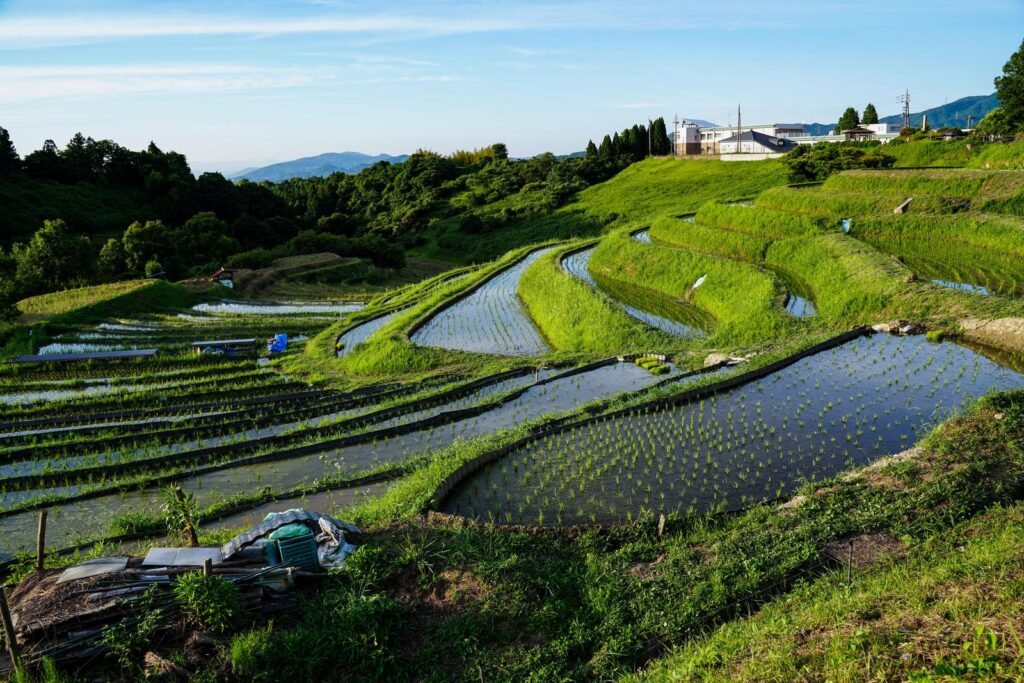
The Ohmi Shonin saying — “set up shop where, for three ri around, people eat rice from the pot” — can, as noted above, be taken plainly to mean: identify the places where demand exists. Yet the author suspects there may be a deeper meaning beneath it as well.
One reading is this: even a place that appears deserted may hold more people than one would expect, so take care not to miss a commercial opportunity. People did live in the mountains and elsewhere, yet most Japanese have lived on the plains — and perhaps the saying was also a warning not to be captured by that assumption.
At the same time, there must have been sharp-eyed Ohmi Shonin who could imagine that someone lived even in a seemingly empty place. For them, the saying seems to carry the opposite caution: the mere presence of people is no reason to open an edamise, and one should think carefully about whether a place will actually pay.
Is the author reading too much into it? Perhaps. But these were the Ohmi Shonin — merchants so envied that they were mocked as “Ohmi thieves, Ise beggars” (see Vol. 10). It would be no surprise if they had thought hard about the very limits of where business could be done.
OHYASHIMA is seeking information about the Ohmi Shonin
In connection with this series, OHYASHIMA welcomes information about the Ohmi Shonin. The author would be particularly grateful to hear from:
- Museum curators and archivists — in Japan or elsewhere — who hold collections related to the Ohmi Shonin
- Those who work for companies with ties to the Ohmi Shonin, or whose own ancestors were Ohmi Shonin
- Those who know of Ohmi Shonin merchants who conducted business outside Japan
OHYASHIMAは近江商人に関する情報を求めています
本連載にあたり、近江商人に関する情報を募集しています。たとえば、下記に該当する方はぜひご存じの情報をお寄せください。
- 日本国内外を問わず、近江商人に関する所蔵品がある博物館などの学芸員の方
- 近江商人と関連のある企業にお勤めの方、先祖などに近江商人がいらっしゃる方
- 日本国外でビジネスをした近江商人についてご存じの方
*¹ Ohmi Shonin-gaku Nyumon — CSR no Genryu ‘Sanpo Yoshi’ — Kaitei-ban, Kunitoshi Suenaga, Sunrise Publishing
*²Japan’s Richest Domains in the Edo Period, nippon.com
*³Wealthy Western Domains in the Edo Period, nippon.com
*⁴National Atlas of Japan (reference materials), Geospatial Information Authority of Japan