
Reading the full series? Browse all volumes here.
Before diving in — Vol. 2 sets out the author’s framing and caveats.
In 1211, Shinran was pardoned. After spending around two more years in Echigo, he moved to the eastern provinces known as Togoku — present-day Kanto — and spread the teaching of Tariki (Other Power) there. His base was Hitachi Province, present-day Ibaraki Prefecture.
The Kanto region in Shinran’s time
Why did Shinran choose to spread his teaching in the east? Scholars hold differing views, and there is no definitive answer.*¹
Before addressing that question, however, some context is needed. OHYASHIMA is written for readers who do business in Japan or are considering doing so, and without a sense of what the eastern provinces — the Kanto region — were like at the time, it would be difficult to picture Shinran carrying out his mission there.
Today, the Kanto region is home to around 46 million people.*² With Japan’s total population at 123 million, that means close to 40% of the country lives in Kanto. The reason for such concentration is that Kanto contains the capital, Tokyo, the centre of Japan’s politics and economy, and so people gather not only in Tokyo itself but also in the areas around it. As a slight digression, this situation has made correcting the over-concentration in Tokyo and the wider capital region a recurring subject of debate in Japan.
In Shinran’s time, however, the centre of Japan was Kyo (Kyoto). The era is now known as the Kamakura period, after Yoritomo Minamoto, a warrior who established his base in what is now Kamakura City, Kanagawa Prefecture (Kanagawa is also one of the prefectures of the Kanto region and borders Tokyo). Kamakura, however, was merely the seat of the warrior government; most members of the imperial family and the aristocracy continued to live in Kyo, which also remained the economic centre.*³
Kamakura aside, then, the Kanto region of the time was Japan’s “countryside”.
Returning to the question of why Shinran was active in the east, it seems plausible that at least part of the answer lies in the east being an easier place to work than Kyo, where he himself had been persecuted.
Toku and hiso hizoku: neither monk nor layman
Shinran was born the son of a low-ranking aristocrat and entered the priesthood. After coming down from Mount Hiei, he became a disciple of Honen, who gave him the monastic name Shakku. Then, in the Ken’ei Persecution (also known as the Jogen Persecution), he was stripped of his monastic status as punishment and made to take the lay name Yoshizane Fujii.
Having been pardoned, however, he no longer needed to go by Yoshizane Fujii. It was probably around this time that he began calling himself Shinran: his major work, the Kyogyoshinsho, is thought to have been begun while he was in the east, and the name Shinran appears in it. The name takes one character each from Tenjin (Vasubandhu), an eminent Indian monk of around the fourth century, and Donran (Tanluan), a key figure in Chinese Pure Land Buddhism who lived in the fifth and sixth centuries.
Shinran also referred to himself as Toku and Gutoku. The character used to write Toku can also mean “bald”. Here, however, Toku does not refer to hair that has stopped growing. In Buddhism, monks shave their heads as a sign of having left secular life; Toku describes the state in which the hair has grown back a little after shaving.
Shinran regarded himself as neither a layperson nor an ordained monk. This is known as hiso hizoku — neither monk nor layman — and his self-designation, Toku, came to symbolise it. The Gu in Gutoku, incidentally, means “foolish” — an expression of humility, one might say.
Even readers unfamiliar with Buddhism probably picture Asian Buddhist monks with shaven heads. Jodo Shinshu, however, is different. Its priests are permitted to grow their hair, and Kojun Ohtani, the current Monshu (head of the school) of Jodo Shinshu Hongwanji-ha, has hair long enough to hide his scalp entirely, as the photograph below shows.
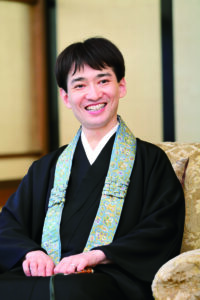
Hongwanji-ha has Nishi Honganji as its head temple. Choyu Otani, the Monshu of Shinshu Otani-ha — whose head temple is Higashi Honganji (officially named Shinshu Honbyo, though the more familiar name is used here for clarity) — also wears his hair long.*⁴
The heads of Jodo Shinshu Hongwanji-ha and Shinshu Otani-ha share the surname Ohtani (Otani) because both are descendants of Shinran. That said, Honganji split into east and west between the Azuchi-Momoyama and Edo periods, so their common ancestor lived some 400 years ago. The story of Jodo Shinshu after Shinran will be taken up on another occasion.
The rule allowing Jodo Shinshu priests to grow their hair symbolises the fact that, although they are not of the laity, they live alongside lay followers. This is precisely why priests and lay followers are closer in Jodo Shinshu than in other schools of Japanese Buddhism.
The religious studies scholar Hiromi Shimada describes the character of Jodo Shinshu, drawing on his own experience:
“Because my speciality is the study of religion, I am often invited by Buddhist schools to give lectures. (…)
One school whose character stands out is Jodo Shinshu. Because priests and the lay followers known as monto are close, the monto do not put priests on a pedestal. What is more, they show no reserve even towards lecturers like me, and I sometimes receive scathing criticism.”*⁵
As discussed in Vol. 27, one of the core teachings of Jodo Shinshu is Akunin Shoki — the idea that the wicked are the very people Amida Buddha seeks to save. This will be covered in the next instalment, but Shinran’s missionary work across the eastern provinces arguably helped this novel idea win acceptance among many people. Indeed, Jodo Shinshu Hongwanji-ha and Shinshu Otani-ha together have more than 14 million followers today, making Jodo Shinshu the largest force in Japanese Buddhism (Jodo Shinshu has other schools besides these two, such as Takada-ha).*⁶
At the same time, the author senses that another reason Jodo Shinshu won such wide acceptance is that ordained priests and lay followers could talk to each other as equals. The author also believes that Jodo Shinshu’s ideas about equal relationships between people influenced the Ohmi Shonin who followed or took an interest in it. This, too, will be explored in a future instalment.
OHYASHIMA is seeking information about the Ohmi Shonin
In connection with this series, OHYASHIMA welcomes information about the Ohmi Shonin. The author would be particularly grateful to hear from:
- Museum curators and archivists — in Japan or elsewhere — who hold collections related to the Ohmi Shonin
- Those who work for companies with ties to the Ohmi Shonin, or whose own ancestors were Ohmi Shonin
- Those who know of Ohmi Shonin merchants who conducted business outside Japan
OHYASHIMAは近江商人に関する情報を求めています
本連載にあたり、近江商人に関する情報を募集しています。たとえば、下記に該当する方はぜひご存じの情報をお寄せください。
- 日本国内外を問わず、近江商人に関する所蔵品がある博物館などの学芸員の方
- 近江商人と関連のある企業にお勤めの方、先祖などに近江商人がいらっしゃる方
- 日本国外でビジネスをした近江商人についてご存じの方
*¹ What Is Jodo Shinshu? Shinran’s Teaching and Its Lineage, Satoko Koyama, Chuko Shinsho
*² Population Data for Japan by Region, e-Stat (2024)
*³ Learning about History and Culture, Kyoto School Trip Navi (a website run by the City of Kyoto and the Kyoto Tourism Promotion Council)
*⁴ New Year Dialogue: Chief Administrator Wataru Kigoshi and Monshu Choyu Otani [web edition], Dobo Shimbun, Shinshu Otani-ha (Higashi Honganji)
*⁵ Why Is Jodo Shinshu the Largest School in Japan? The Riddle of Buddhist Schools, Hiromi Shimada, Gentosha Shinsho
*⁶ Religious Yearbook, 2025 Edition, Agency for Cultural Affairs