
Reading the full series? Browse all volumes here.
Before diving in — Vol. 2 sets out the author’s framing and caveats.
The past four volumes of this series have looked at the following methods that the Ohmi Shonin used to expand across the country.
- Peddling
- Demise and edamise
- Joint-stock trading
This volume turns to the third of them, joint-stock trading — the method known in Japan as noriai akinai or kumiai akinai.
It is not a difficult idea. Companies today will likewise put up capital together for a single purpose and launch a new company between them. It is something seen in many countries. This is the same thing.
An example of joint-stock trading by the Genzaemon Nakai family
According to Kunitoshi Suenaga, the Ohmi Shonin drew on joint-stock trading when they opened branch shops — that is, presumably, demise and edamise — and when they started businesses that called for capital expenditure and upfront investment, such as brewing.*¹
The Sendai shop of the Genzaemon Nakai family (on the man himself, see Vol. 12), for instance, began through joint-stock trading among people connected to the house. Alongside the first-generation Genzaemon, the names of Shin-emon Yano, Sukeemon Ida, Kuemon Sugii and Sohei Wakimura appear on the list.
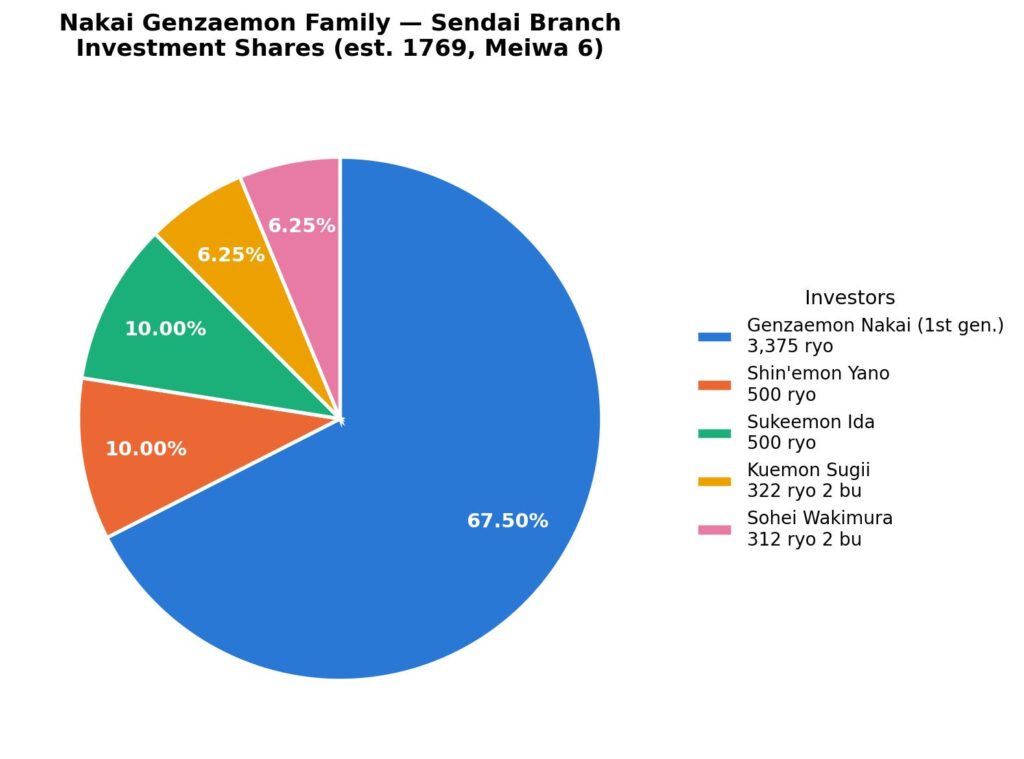
Suenaga adds that the investors in this case bore unlimited liability. The Sendai shop later passed into the sole management of the Nakai family, after the Tenmei famine (1782–1787, a famine brought on in part by cold-weather crop damage)*² coincided with the Sendai domain’s han-satsu (the paper currency issued by the domain itself) ceasing to circulate, among other troubles. In this instance, unforeseen events led the other investors to pull out.
Why brewing cost money
As noted above, joint-stock trading was put to use in businesses that required capital expenditure and upfront investment, brewing among them.
Japan has a great many fermented foods to begin with. Sake is one, and so are miso and soy sauce, both of them essential ingredients and seasonings in Japanese cooking. This has much to do with the variety of brewers and fermenters to be found in Japan, in the present as in the past. In Gunma Prefecture, for one, there is a soy sauce maker called Okazaki Shoyu*³ that was founded by an Ohmi Shonin.
Brewing does indeed cost money. The fermentation vats it uses are large, and the kettle room is a facility that takes up a fair amount of space in its own right.
Rulers, moreover, have taxed alcohol since early times, in the West and the East alike. Sake in Japan was, of course, no exception.
In Edo-period Japan, only those who had obtained a shuzo kabu or sake kabu from the shogunate were permitted to brew.*⁴ Kabu translates into English as “stock”, but in this case it is better rendered as a business permit, or a brewing licence. Tax was levied on the shuzo kabu in proportion to the output it authorised.*⁵
Nor was a shuzo kabu something anyone could obtain simply by applying for one. Their number was limited, and a newcomer to the trade sometimes had to buy a kabu from an operator already in business.*⁶ In such cases the seller will naturally have named a high price often enough.
The Ohmi Shonin did business even in places to which they had no ties of their own. In other ventures that carried heavy costs, and not in brewing alone, various shonin (merchants) put up capital together and opened up new ground.
OHYASHIMA is seeking information about the Ohmi Shonin
In connection with this series, OHYASHIMA welcomes information about the Ohmi Shonin. The author would be particularly grateful to hear from:
- Museum curators and archivists — in Japan or elsewhere — who hold collections related to the Ohmi Shonin
- Those who work for companies with ties to the Ohmi Shonin, or whose own ancestors were Ohmi Shonin
- Those who know of Ohmi Shonin merchants who conducted business outside Japan
OHYASHIMAは近江商人に関する情報を求めています
本連載にあたり、近江商人に関する情報を募集しています。たとえば、下記に該当する方はぜひご存じの情報をお寄せください。
- 日本国内外を問わず、近江商人に関する所蔵品がある博物館などの学芸員の方
- 近江商人と関連のある企業にお勤めの方、先祖などに近江商人がいらっしゃる方
- 日本国外でビジネスをした近江商人についてご存じの方
*¹Ohmi Shonin-gaku Nyumon — CSR no Genryu ‘Sanpo Yoshi’ — Kaitei-ban, Kunitoshi Suenaga, Sunrise Publishing
*²The Tenmei Famine and Fishing Villages as Seen through the Same Goyakusho Nikki: The Case of the Hachinohe Domain, Tsunetoshi Mizoguchi
*³Okazaki Shoyu
*⁴The Edo Shogunate and the Sake Brewing Industry, Sake Museum
*⁵Surveys of Sake Brewing Rice Volumes and Taxation in the Edo Period, National Tax Agency
*⁶Accounts of the sake brewing industry in the Oamishirasato Town History