Reading the full series? Browse all volumes here.
Before diving in — Vol. 2 sets out the author’s framing and caveats.
As covered in Vol. 7, the merchants known as Ohmi Shonin did not conduct business in their home region of Ohmi. Instead, they traveled throughout Japan, and sometimes set up shop in the very places they traveled to, carrying out trade there.
The Ohmi Shonin conducted business as outsiders. As outsiders, they were required to be loved and trusted by their buyers. It was for this reason that the idea of Kai-te Yoshi — good for the buyer — took root, as the author has already noted.
So where were those buyers? Where did Ohmi Shonin travel to?
To give the conclusion first: Ohmi Shonin had spread to every part of Japan — save for present-day Okinawa — by the 18th and 19th centuries. In Hokkaido, however, they were limited to the southern areas such as Hakodate, where the authority of the Tokugawa regime extended.
Ideally, the author would like to explain this with a map. However, producing one proved beyond the author’s abilities as a non-professional in design. Japanese condiment makerMizkan has published on its websitean explanation of the Ohmi Shonin written by Hideki Usami, a prominent Ohmi Shonin scholar and Professor Emeritus (Professor at the time of publication) in the Faculty of Economics at Shiga University. That page features an easy-to-read map of the locations where Ohmi Shonin conducted business; please follow the link to view it.
Ohmi Shonin’s business activities also extended beyond Japan, as early as the 17th century.
Two Ohmi Shonin are academically recognized as having ventured outside Japan in the 17th century: Taro-emon Nishimura and Kanbei Siamroya.
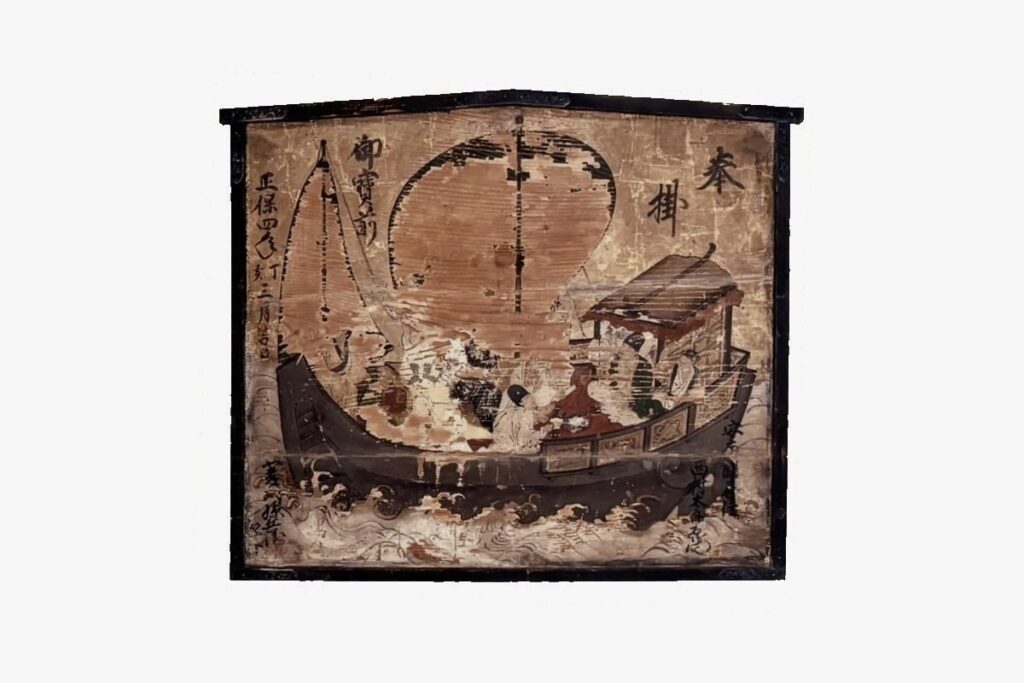
Of the two, Taro-emon Nishimura is said to have traveled to Vietnam aboard a trading vessel known as a shuinsen, conducting business there. He subsequently returned to Japan, but by then the Tokugawa regime had been established and strict restrictions had been placed on foreign relations; Nishimura found himself detained in Nagasaki, with no choice but to return to Vietnam. Whether as a stand-in for himself or for some other reason,Nishimura dedicated a votive tablet — an ema, a wooden plaque on which wishes and prayers are written and offered at shrines and temples — to the Himure Hachimangu shrine in Ohmi.
Kanbei Siamroya was an Ohmi Shonin who traveled to Thailand and traded with his home country of Japan in goods including textiles dyed using a technique called Siamro-zome. Ohmi Shonin. Siam is the old name for Thailand. Compared withNishimura, Kanbei Siamroya’s records are scarce.
Both men are said to have achieved a degree of success, and Ohmi Shonin’s philosophy of Kai-te Yoshi — and of Sanpo Yoshi more broadly — could be said to have held up even outside Japan.
It was also noted above that throughout Japan except for Okinawa, Ohmi Shonin conducted business. Yet they had already expanded into Southeast Asia — which lies beyond Okinawa when viewed from Ohmi. It is therefore possible that the Ohmi Shonin did in fact enter Okinawa, which was then Ohmi Shonin the Kingdom of Ryukyu.
Ohmi-dorobo, Ise-kojiki
The author must, however, walk back a previous statement: Ohmi Shonin apparently were not always understood, and seem at times to have been disliked by people in the various places they operated, no matter how faithfully they adhered to the principles of Kai-te Yoshi or Sanpo Yoshi.
Ohmi-dorobo, Ise-kojiki” (dorobo: thief; kojiki: beggar). The phrase is not much used in contemporary Japan.
The “Ise” in the second half of the phrase refers to an area to the southeast of Ohmi, corresponding to present-day Mie Prefecture. Ise, too, was a region that produced many accomplished Shonin. Ohmi, Ise, and Osaka together are sometimes called the “three great Shonin regions of Japan.”
Among the Ise Shonin, the most particularly famous is Takatoshi Mitsui, who founded Echigoya in Edo in the 17th century. Echigoya is the origin of Mitsui & Co. & Co. and the present-day Mitsui Group Group.
Takatoshi Mitsui’s grandfather was named Takayasu.*¹ Takayasu was a samurai from a place in Ohmi called Namazue. Namazue now falls within Higashiohmi City, the Ohmi Shonin Kyodo-kan featured in the previous volume, located just over two kilometers (1.2 miles) to the south.
Takatoshi Mitsui was thus an Ise Shonin with roots in Ohmi as well. To begin with, Ohmi and Ise are neighboring regions. There may well be other cases in which Ohmi Shonin and Ise Shonin intersected in some way — instances that simply went unrecorded.
To return to the main subject.
“Ohmi-dorobo, Ise-kojiki” is said by some to have originated as a jibe by samurai and Confucian scholars directed at Shonin,*² and by others to have been coined out of jealousy by Shonin based in Edo.*³ The Ohmi Shonin were likened to thieves for the way their commercial acumen allowed them to clinch deals, while the Ise Shonin were compared to beggars for the way they succeeded through diligent frugality.*⁴
If one takes the words at face value and considers the feelings of whoever coined the phrase, it is hard to believe they held a favorable impression of the Ohmi Shonin or Ise Shonin. Then again, it may have been said partly in jest; yet as the phrase spread, there were those who genuinely harbored resentment toward the Ohmi Shonin and Ise Shonin.
Whenever someone profits in business, there will always be those who take a dim view of it.
Yet there are facts that must be acknowledged at the same time. As the author has discussed throughout this series, there are numerous companies still in existence today that trace their origins to the Ohmi Shonin, and academic research into the progressiveness of Sanpo Yoshi-style business continues to this day.
No matter how faithfully the Ohmi Shonin pursued business in the spirit of Sanpo Yoshi, there were probably always those who viewed them unfavorably. And yet the ideal of Sanpo Yoshi lived on, and the Ohmi Shonin’s presence continues to make itself felt in Japan today.
OHYASHIMA is seeking information about the Ohmi Shonin
In connection with this series, OHYASHIMA welcomes information about the Ohmi Shonin. The author would be particularly grateful to hear from:
- Museum curators and archivists — in Japan or elsewhere — who hold collections related to the Ohmi Shonin
- Those who work for companies with ties to the Ohmi Shonin, or whose own ancestors were Ohmi Shonin
- Those who know of Ohmi Shonin merchants who conducted business outside Japan
OHYASHIMAは近江商人に関する情報を求めています
本連載にあたり、近江商人に関する情報を募集しています。たとえば、下記に該当する方はぜひご存じの情報をお寄せください。
- 日本国内外を問わず、近江商人に関する所蔵品がある博物館などの学芸員の方
- 近江商人と関連のある企業にお勤めの方、先祖などに近江商人がいらっしゃる方
- 日本国外でビジネスをした近江商人についてご存じの方
*¹“Matsusaka no Chi de Hagukumareta Mitsui no Kokoro,” Mitsui Public Relations Committee
*² Ohmi Shonin-gaku Nyumon — CSR no Genryu ‘Sanpo Yoshi’ — Kaitei-ban, Kunitoshi Suenaga, Sunrise Publishing
*³“Ise Shonin no Katsuyaku to Mitsui Takayoshi no Shoho,” Mie Prefecture
*⁴ Daijisen (Japanese dictionary), iOS app edition