Reading the full series? Browse all volumes here.
Before diving in — Vol. 2 sets out the author’s framing and caveats.
Before turning to seller’s benefit, there is a phrase that encapsulates the discipline expected of the seller — the Ohmi Shonin. That phrase is “shimatsu shite kibaru.”
When shimatsu is used by Japanese people today, it tends to mean properly disposing of something or tidying up a problem. The Ohmi Shonin, however, used the word less in the sense of discarding things and more in the sense of using them to the last without waste. In the contemporary language of environmental stewardship, it is a word that corresponds to reuse and recycle.
As for kibaru, Kunitoshi Suenaga, professor emeritus at Doshisha University and a scholar of the Ohmi Shonin, explains that it means to work diligently. Suenaga also notes that in present-day Shiga Prefecture — the area that corresponds to the old province of Ohmi — the greeting “okibari yasu” remains in common use: a phrase that conveys a celebratory sense of “how good that you are able to work with energy.” *¹
In short, shimatsu shite kibaru means to cherish one’s possessions, to be frugal, and to work with all one’s effort. It is also a phrase that recurs time and again when one visits museums and other facilities associated with the Ohmi Shonin, or reads the literature about them.
A Window into the Ohmi Shonin’s Practice of Shimatsu
The author witnessed this spirit of shimatsu shite kibaru firsthand at the Ohmi Shonin Kyodokan in Higashiomi, Shiga Prefecture, where Suenaga serves as director. The museum makes use of the original residence of Gin-emon Kobayashi, an Ohmi Shonin of the eighteenth and nineteenth centuries, as an archive and exhibition space. The first Gin-emon operated under the trade name “Chogin” and built his fortune as a hemp cloth merchant. Chogin has since been incorporated as a textile trading company, and the Kobayashi family continues to lead its management.
With this background, the Ohmi Shonin Kyodokan holds extensive archival materials relating to the Kobayashi family and Chogin. One of its holdings is the photograph below.
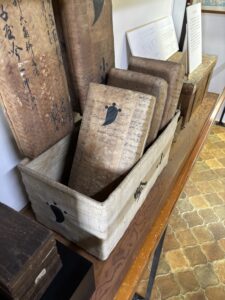
The black crest at the centre of the lid is immediately striking. This is Chogin’s crest, whose motif is the clove. And one can see that the rest of the surface is covered in a great number of written characters.
The lid is made from used paper that Chogin had employed in its business, with multiple layers pressed together to ensure durability. The profusion of characters on the surface beyond the crest are traces of what were once notes, letters, or similar documents.
To this degree did Chogin’s proprietors and employees carry the practice of shimatsu.
Genzaemon Nakai’s Doctrine of “Shimatsu First”
And the importance placed on shimatsu was not unique to Chogin — it was shared by the Ohmi Shonin at large.
Genzaemon Nakai, an eighteenth-century Ohmi Shonin, left behind a document known as the Kanemochi Shonin Ichimai Kishomon — a text addressed to those who wish to become wealthy, setting out how that might be achieved. The passage relating to shimatsu, taken from a modern Japanese rendering of the Kishomon, reads as follows.
《Many people say that those whose wealth accumulates have luck, and that they themselves do not. This is a great mistake. There is no such thing as luck. If one truly wishes to become wealthy, there is nothing for it but to forgo banquets, pleasures, and extravagance; to take care of one’s health; and to put shimatsu — frugality — first in one’s trade.》*²
The author believes this way of thinking is not confined to the Ohmi Shonin.
Warren Buffett, the investor who has featured several times in this series, for instance, continues to live in the house he purchased some seventy years ago. *³
Buffett’s friend Bill Gates is likewise a man who practises shimatsu. According to Susumu “Sam” Furukawa, the founding president of Microsoft Japan, Gates once flew from Japan to South Korea and, upon seeing “first class” printed on his boarding pass, flew into a rage. To quote Furukawa’s own recollection directly: “Sam, is this the kind of company — the Microsoft Japan you’re running for me — that wastes money like this? What is this first-class boarding pass? Why are you spending the company’s money so wastefully on a flight of barely an hour?” — and Gates let loose at him. *⁴ There is, however, a punchline: the ticket was not a discounted fare but a full-price ticket, which meant it was automatically upgraded to a higher class whenever space was available. Once Gates learned this, he apologised to Furukawa.
What the author wishes to convey, of course, is that Gates practises shimatsu as a matter of course — and that many successful businesspeople place shimatsu at the centre of their lives.
OHYASHIMA is seeking information about the Ohmi Shonin
In connection with this series, OHYASHIMA welcomes information about the Ohmi Shonin. The author would be particularly grateful to hear from:
- Museum curators and archivists — in Japan or elsewhere — who hold collections related to the Ohmi Shonin
- Those who work for companies with ties to the Ohmi Shonin, or whose own ancestors were Ohmi Shonin
- Those who know of Ohmi Shonin merchants who conducted business outside Japan
OHYASHIMAは近江商人に関する情報を求めています
本連載にあたり、近江商人に関する情報を募集しています。たとえば、下記に該当する方はぜひご存じの情報をお寄せください。
- 日本国内外を問わず、近江商人に関する所蔵品がある博物館などの学芸員の方
- 近江商人と関連のある企業にお勤めの方、先祖などに近江商人がいらっしゃる方
- 日本国外でビジネスをした近江商人についてご存じの方
*¹ Ohmi Shonin-gaku Nyumon — CSR no Genryu ‘Sanpo Yoshi’ — Kaitei-ban, Kunitoshi Suenaga, Sunrise Shuppan, Sunrise Publishing
*² From the exhibition materials at the Ohmi Hino Shonin Furusatokan
*³ 『Luxury isn’t about owning things’ — Warren Buffett at 90 on true abundance [Innovative Senior Innovators Changing the World]』, Masami Yokoyama, VOGUE JAPAN (digital edition)
*⁴ “The Bill Gates I Knew, Part 6” — note by Susumu “Sam” Furukawa