
Reading the full series? Browse all volumes here.
Before diving in — Vol. 2 sets out the author’s framing and caveats.
When this series turned to the demise and edamise, it noted that such shops were staffed entirely by men from Ohmi, and that the women worked at the honke, the head house.
Women at the honke performed work close to domestic labour: cooking for the shop staff, doing the laundry and so on. At the risk of repeating Vol. 17, by modern lights this amounts to a restriction of occupational roles by sex, and the author has no wish to deny it.
Yet it would be a mistake to overlook the important part women played in management.
The master of a house with demise and edamise — always a man — was frequently away from the honke, touring the regions where his shops stood. The honke itself, however, generated no shortage of work: managing merchandise and the provisions for the shop servants and dispatching them to each demise and edamise; recruiting those who sought positions as servants through local or family connections; and maintaining relations with other merchant houses.
Who did all of this? The master’s wife.
The Ohmi Shonin’s wife as “business partner”
Let us look more closely.
The heaviest responsibilities carried by the master’s wife concerned money and goods. She handled the finances and the stock, in other words, and so contributed directly to keeping the shop from failing and to making it prosper. “Goods” here meant not only merchandise but also, as noted above, the servants’ provisions and their shikise — the clothing a master supplied to his servants.
The wife also played a large part in the education of both the heir and the servants. In the latter case her duties extended beyond recruitment to judging each servant’s aptitude and deciding which demise he should be posted to, and to retraining those who had been sent back to Ohmi after some misconduct so that they might return to work.
As to the former: when Zenzo became the young head of the Zenkuro Nishitani house, his mother — the wife of the previous master — sent him a letter setting out what was expected of an heir in training. In the modern-Japanese rendering reproduced in Kunitoshi Suenaga’s book*¹, she instructs him to apply himself diligently to learning the family trade; to admonish anyone who behaves improperly in private, while praising good conduct so that everyone hears of it; to heed the counsel of the senior shop staff; never to let anger show in his face or his words, however hard it may be to bear; and, since this is a period of apprenticeship, to refrain entirely from interfering and confine himself to observation.
Suenaga describes the master’s wife, who shouldered the whole of the work at the honke in this way, as having served as a partner in the business. The author agrees, and would put it in contemporary terms: the wife of an Ohmi Shonin did work equivalent to that of a co-chief executive or a chief financial officer.
A school for the wives of Ohmi Shonin
Some readers may object that the master’s wife, however low the status of women in that era, stood in a different position from other women. Again, the author has no wish to deny it.
There was, however, one wife of an Ohmi Shonin who did not devote herself to business alone, but sought to protect the position of women through education. Her name was Sato Tsukamoto.
She was the fifth daughter of the first Sadaemon Tsukamoto, an Ohmi Shonin whose house survives today in corporate form as the textile trading company Tsukamoto Corporation. She married Genzo — later known as Genzaburo — a servant of the Tsukamoto house. Genzo entered the family and then went on to establish a branch house of his own. Sato was thus both the child of an Ohmi Shonin and the wife of one: an instance of the pattern touched on in Vol. 17, in which a promising servant is taken as a son-in-law.
That life shaped her convictions. People of the coming age, she came to believe, should marry partners they had chosen themselves and on the merits of the person, rather than at their parents’ direction; and women, whose position was weak, should acquire knowledge and a skill so that they might live independently even if widowed.*²
Sato went on to found a girls’ school in Gokasho: the private Tankai Joshi Jitsumu Gakko, or Tankai Practical School for Girls.
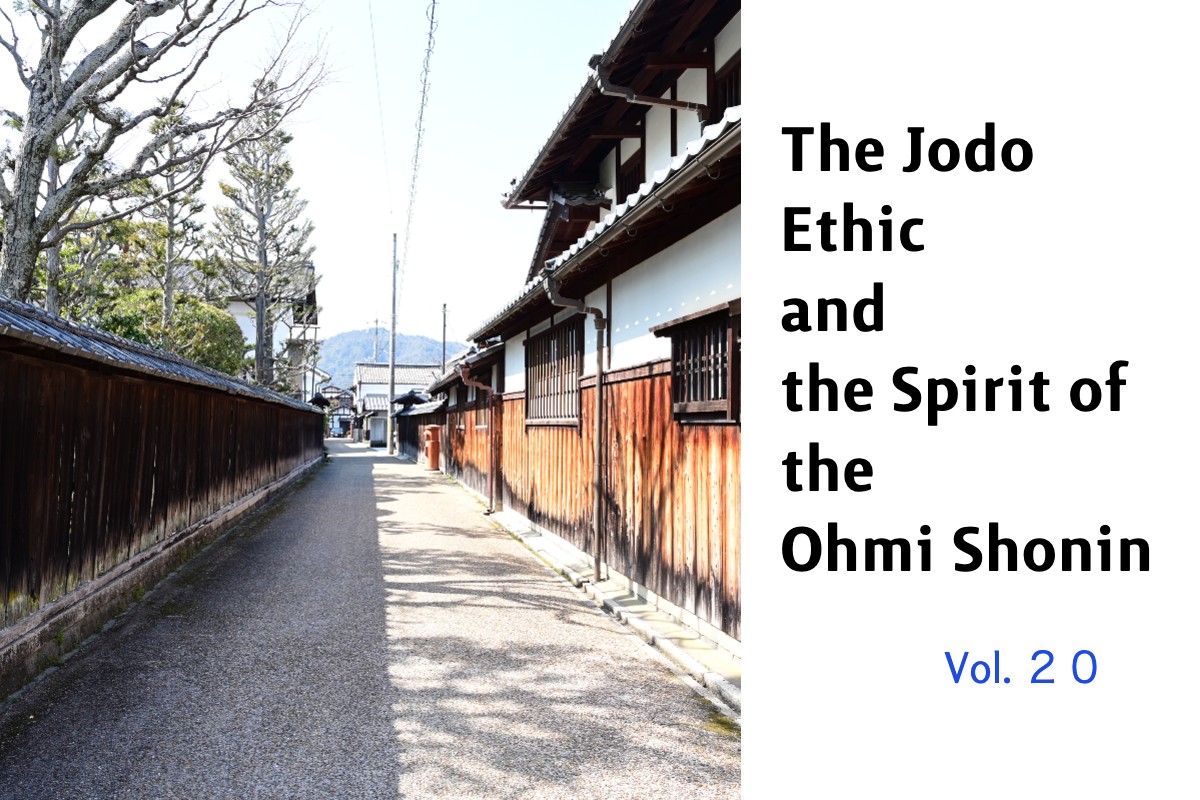
Gokasho produced a great many Ohmi Shonin. Besides the Tsukamoto there were the Nakae, who ran department stores on the Korean peninsula under Japanese rule; the Tonomura, known also for producing the noted novelist Shigeru; and the Fujii, who made their fortune with the “Ski” knitting-wool brand. Gokasho today forms part of Higashiohmi City. The photograph currently heading this series was taken in the Kondo district of Gokasho.
The school was founded in 1919. Compulsory education in Japan at that point covered the ordinary elementary school course alone; there was no obligation to attend a middle school, a girls’ high school (koto jogakko) or a higher elementary school.*³ Entry to the Tankai school followed the requirements for a girls’ high school: applicants had to be at least twelve years old and to have completed ordinary elementary school. In 1926 it received official approval and formally became a girls’ high school.
The curriculum of a typical girls’ high school centred on general education — Japanese, foreign languages, mathematics and the like.*⁴ The Tankai school, by contrast, taught commerce, domestic management, sewing, handicrafts and etiquette alongside those general subjects. This was plainly a curriculum designed to equip a woman to take her place as the wife of an Ohmi Shonin. It also suggests, in line with Sato’s concern, an education that would allow a woman to carry on the house or to support herself by some skill even after losing her husband.
The school’s own bulletin put it in these terms: alongside a higher general education, it would cultivate a commercial cast of mind and a mastery of practical household affairs, and so train sound merchant-house mistresses suited to the age.
In 1947, after Japan’s defeat in the Second World War, compulsory education was extended through lower secondary school. Girls of the age that would once have taken them to a girls’ high school now went to a lower secondary school instead. Tankai Girls’ High School changed both its name and its form after the war, becoming first the Tankai Higher School of Domestic Science and then the Tankai Girls’ Vocational School. As the economy grew, however, so did the proportion of women continuing their studies, and by the 1970s almost all of them were going on to upper secondary school.*⁵ Against that background the school Sato had built saw its enrolment fall, and it closed in 1985.
On the site where the Tankai Practical School for Girls once stood there is now the Tankai College of Calligraphic Culture — the same institution in organisational terms, but co-educational and with a wholly different educational purpose. Shodo, or calligraphy, is the East Asian brush art akin to Western calligraphy.
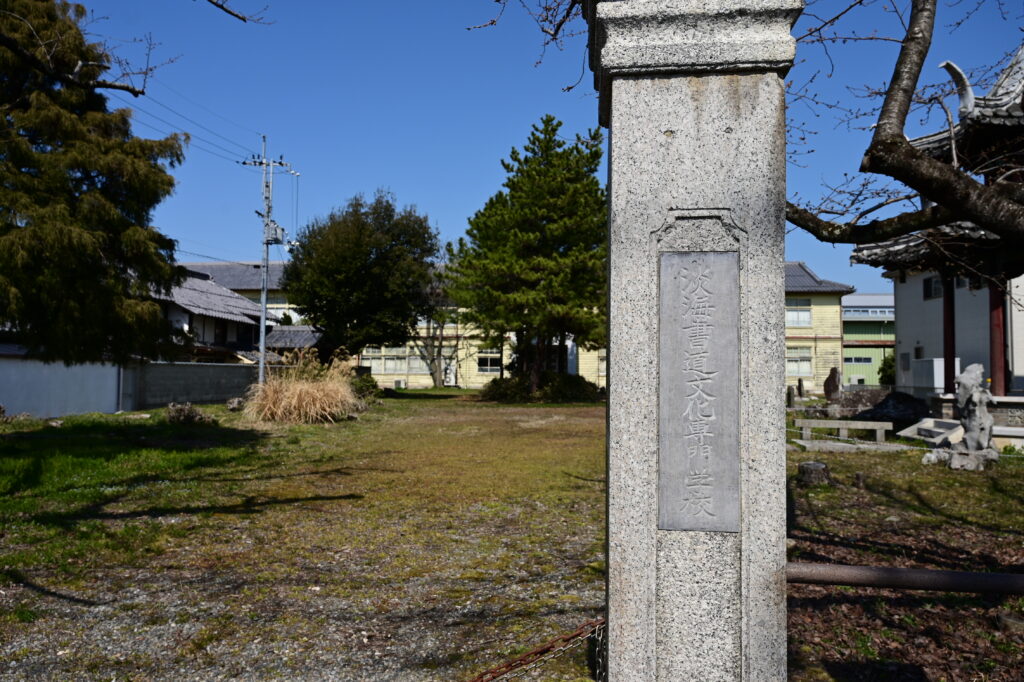
Sato Tsukamoto’s noblesse oblige, Ohmi style
It is worth recalling that from the Edo period (17th–19th centuries) onwards, a boy who set his sights on becoming an Ohmi Shonin entered service as a detchi, or apprentice, at the age of twelve, and was promoted to tedai, or clerk, after his hatsunobori — his first authorised return home. In the Meiji era that followed, there must likewise have been boys who finished ordinary elementary school and went straight into apprenticeship.
At the same time, and with the express aim of training merchants, Shiga Commercial School was established some thirty years before the Tankai school — the institution later renamed Hachiman Commercial School, and known today as Shiga Prefectural Hachiman Commercial High School. That too was in the Meiji era.
Ohmi, in short, was a region with an unusual appetite for giving both men and women an education in commercial life. There was a time when Japanese women were told that learning was wasted on them; but men, too, heard that study would take their minds off their work, and that reading books would turn them “red” — that is, communist. Even allowing for the fact that the purpose was economic prosperity, Ohmi’s enthusiasm for education looks high by comparison with other parts of Japan.
Since her death in 1928, few outside the region have known the name of Sato Tsukamoto. The author wishes to record here that she turned the position she held as the wife of an Ohmi Shonin to good account — that she embodied, one might say, a noblesse oblige of the Ohmi kind.
OHYASHIMA is seeking information about the Ohmi Shonin
In connection with this series, OHYASHIMA welcomes information about the Ohmi Shonin. The author would be particularly grateful to hear from:
- Museum curators and archivists — in Japan or elsewhere — who hold collections related to the Ohmi Shonin
- Those who work for companies with ties to the Ohmi Shonin, or whose own ancestors were Ohmi Shonin
- Those who know of Ohmi Shonin merchants who conducted business outside Japan
OHYASHIMAは近江商人に関する情報を求めています
本連載にあたり、近江商人に関する情報を募集しています。たとえば、下記に該当する方はぜひご存じの情報をお寄せください。
- 日本国内外を問わず、近江商人に関する所蔵品がある博物館などの学芸員の方
- 近江商人と関連のある企業にお勤めの方、先祖などに近江商人がいらっしゃる方
- 日本国外でビジネスをした近江商人についてご存じの方
*¹ Ohmi Shonin-gaku Nyumon — CSR no Genryu “Sanpo Yoshi” — Kaitei-ban (An Introduction to the Study of the Ohmi Shonin: “Sanpo Yoshi”, the Origins of CSR, revised edition), Kunitoshi Suenaga, Sunrise Publishing
*² “Women’s Education in the Home Region of the Ohmi Shonin: From Utako Shimoda to Sato Tsukamoto”, pamphlet, Ohmi Shonin Museum, Higashiohmi City
*³ Gakusei Hyakunen-shi: Shiryo-hen (One Hundred Years of the School System: Documentary Volume), Ministry of Education, Culture, Sports, Science and Technology
*⁴ Gakusei Hyakunen-shi (One Hundred Years of the School System), Ministry of Education, Culture, Sports, Science and Technology
*⁵ White Paper on Gender Equality 2020, Cabinet Office