

QibiTech, which develops software for the integrated control of robots from different manufacturers, announced on 30 September that it had secured around ¥600m ($3.8m) in a Series B funding round.
The company was founded in 2011 and is headquartered in Tokyo.
What is QibiTech’s HATS?
Factories and warehouses sometimes house robots from several different manufacturers. In recent years, a growing number of startups have been developing solutions for such environments. Mujin, a Japanese startup, for example, specialises in systems and controllers that eliminate the need for teaching — the process of programming a robot to perform its tasks. Mujin’s products enable robots from major manufacturers to operate without teaching.
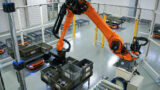
QibiTech develops software that centrally controls robots from a range of manufacturers in facilities such as factories and warehouses (Mujin, mentioned above, also develops an operating system of this kind). The company has named this software HATS. Its applications include running autonomous forklifts (AGFs) efficiently and having inspection and security robots carry out patrols, inspections and record-keeping. In other words, even when a single site hosts many types of robot from multiple manufacturers, they can all be controlled through one piece of software. QibiTech can also support robot deployment using HATS.
Factories in Japan and other countries facing labour shortages are introducing robots to reduce their reliance on manual labour. Beyond that point, however, developing software to operate and control robots from various manufacturers, tailored to each factory, can drive up costs. HATS offers a way to cut the cost of running robots.
QibiTech also highlights that HATS can integrate with higher-level systems such as warehouse management systems (WMS) and manufacturing execution systems (MES), as well as with other equipment. On this point, the author has recently covered MES on several occasions, from hosting a roundtable discussion for an article to attending a related press conference. It may surprise readers in other manufacturing nations, but outside certain industries such as semiconductors and precision equipment, one still comes across mid-sized Japanese companies that have not adopted MES. Behind this lie a tendency to rely on manpower for work that MES could streamline, and a cautious attitude towards digital investment among management.
The author therefore expects that large companies will be the first to put such integrations into practice.
CEO points to pain points on the ground
Participants in the Series B round were JIC Venture Growth Fund 2 Investment Limited Partnership and SVP Open Innovation Fund No. 1 Investment Limited Partnership.
The funds will be used to develop the HATS product, strengthen the company’s sales organisation and recruit talent.
“Expectations for robots are high, but in practice, differences in specifications between manufacturers and the difficulty of operating them in environments shared with people have been obstacles, and robots have struggled to be deployed,” said Ken-ichi Maehara, CEO of QibiTech. “With this funding, we will strengthen our development and sales capabilities and keep moving towards a society in which robots working on site are the norm.”