

OptQC, a developer of photonic quantum computers, announced on 25 August that it had secured ¥7bn ($44m) in a Series A2 funding round.
The company was founded in 2024 by Professor Akira Furusawa of the University of Tokyo’s Graduate School of Engineering, together with Kan Takase, its CEO, and Warit Asavanant, its CTO, both members of the Furusawa laboratory. It is headquartered in Tokyo.
What light offers among the many approaches to quantum computing
The quantum computers that research institutes and startups are now racing to develop come in a variety of architectures, including ion traps, neutral atoms, diamond NV centres and superconducting circuits, as well as photonics. Each faces its own difficulties: the mechanisms tend to be complex, superconducting systems require cooling equipment, and qubits are easily destroyed by noise.
Photonic quantum computers, by contrast, keep complexity down in areas such as wiring; operate at room temperature and so need no cooling equipment (in the case of the approach OptQC has adopted); and, being free of spatial constraints, offer a route to scale, while generating quantum entanglement more readily than other approaches — which OptQC describes as holding and manipulating quantum information stably. A further advantage is that light is already used in telecommunications, so existing technology can be applied. There is a weakness, however: errors arise when light is lost.
OptQC is pursuing the commercialisation of photonic quantum computers using a core technology known as quantum teleportation, which reconstructs the same quantum information at a separate, distant location without ever reading the original. Professor Furusawa demonstrated quantum teleportation of light in 1998. The approach makes quantum computation possible by repeating that teleportation. In July this year, OptQC’s first photonic quantum computer was installed at G-QuAT, the quantum and AI research centre of the National Institute of Advanced Industrial Science and Technology. The company is now working towards commercial deployment of that first machine.
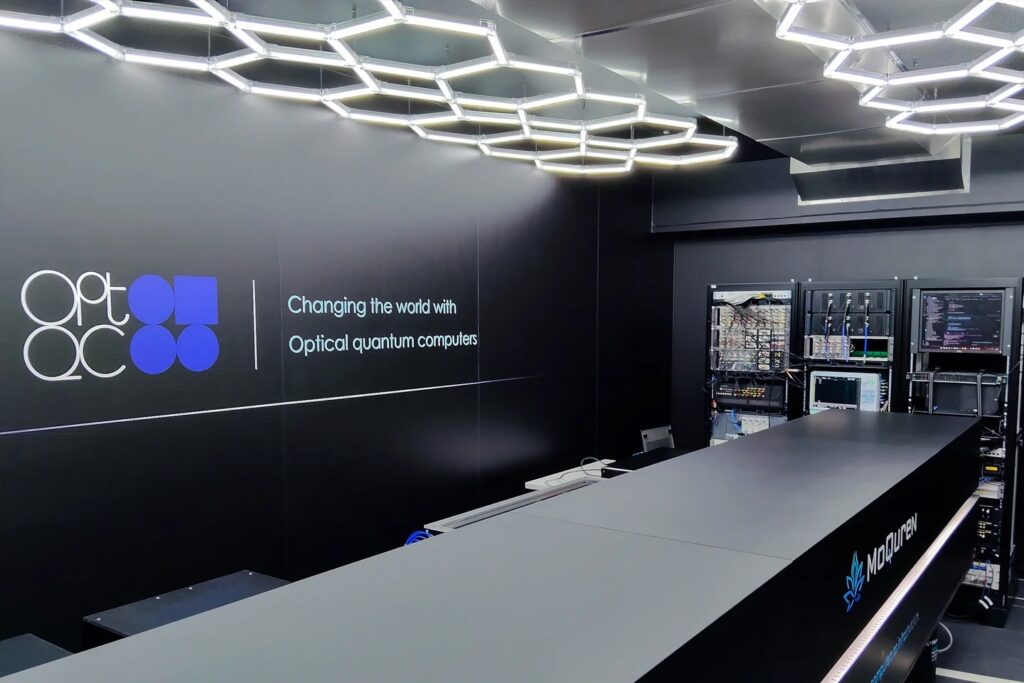
The company has also set out a timeline to commercialise a “high-speed, large-scale model” in the 2028 financial year (April 2028 to March 2029), which it says will substantially exceed the performance of classical computers. It then plans to begin commercial use of a “qubit–analogue hybrid model” in the 2029 financial year, promising computing power and high-capacity communications of a kind not previously available.
Joint research with NTT, the lead investor in the Series A2
The Series A2 was led by NTT, with companies from a range of Japanese industries and venture-capital firms also taking part. NTT, Japan’s largest telecoms company, is promoting IOWN, a communications infrastructure concept built on photonics. On 3 August the two firms concluded a capital and business alliance, under which they say they will carry out joint research.
The funds will go towards research and development of next-generation photonic quantum processors, and towards hiring.
Takase, OptQC’s CEO, commented: “In addition to the venture-capital firms that have backed us since our seed round, we are greatly honoured to welcome leading companies from a wide range of industries — telecommunications, electronics, aviation, precision instruments, finance and property.”