On March 3, Minister of Economy, Trade and Industry Ryosei Akazawa submitted a formal request to Masaaki Shibuya, mayor of Ogasawara Village, Tokyo, to conduct a literature survey as part of the process of selecting a final disposal site for radioactive waste. The survey is specifically intended to focus on Minami-Tori-shima, an island within the village’s jurisdiction.
This article examines the background behind this development.
The Literature Survey Process and Japanese Public Sentiment on Nuclear Power and Final Disposal
One of the pressing global challenges surrounding nuclear power generation is the management of radioactive waste produced through the reprocessing of nuclear fuel. According to the Agency for Natural Resources and Energy, which operates under the supervision of Japan’s Ministry of Economy, Trade and Industry (METI), Finland and Sweden are the only countries in the world that have already selected a site for a final disposal repository. The United States is close to having done so, but the review process remains suspended.
France has advanced to the stage of detailed investigation, while Switzerland, China, and Canada are currently conducting preliminary surveys, which include borehole drilling. Japan, meanwhile, is in the midst of a literature survey—the stage that precedes the preliminary survey. The United Kingdom is another country currently at the literature survey stage.
A literature survey involves the government reviewing geological data and other documentation related to areas that may be suitable for a final disposal site, with materials provided through the cooperation of the relevant local authorities. The request letter submitted by the government on this occasion emphasizes that the survey will be conducted solely with local cooperation—that the government will not proceed without the consent of the municipality—and that it is positioned as “part of an ongoing dialogue.”
As noted above in the overview of each country’s progress, the site selection process involves multiple stages of investigation before a final decision is reached. Accordingly, the commencement of a literature survey does not immediately identify a location as a leading candidate. It is also entirely possible that, following a rigorous assessment, a site could be deemed unsuitable as a final disposal repository.
It is worth also addressing the broader context of final disposal site selection across Japan. The accident at the Fukushima Daiichi Nuclear Power Plant, which occurred in the aftermath of the Great East Japan Earthquake in 2011, led to widespread public aversion to nuclear power in Japan.
Fifteen years have passed since then, however, and that negative sentiment has gradually faded—driven in part by rising energy costs and the rapid expansion of data centers around the world. OHYASHIMA covered the restart of the Kashiwazaki-Kariwa Nuclear Power Plant by Tokyo Electric Power Company (TEPCO—the utility that operated the Fukushima Daiichi plant) in November of last year. The plant has been in operation since February 9 of this year, and its restart did not trigger significant public opposition in Japan.

Why Minami-Tori-shima?
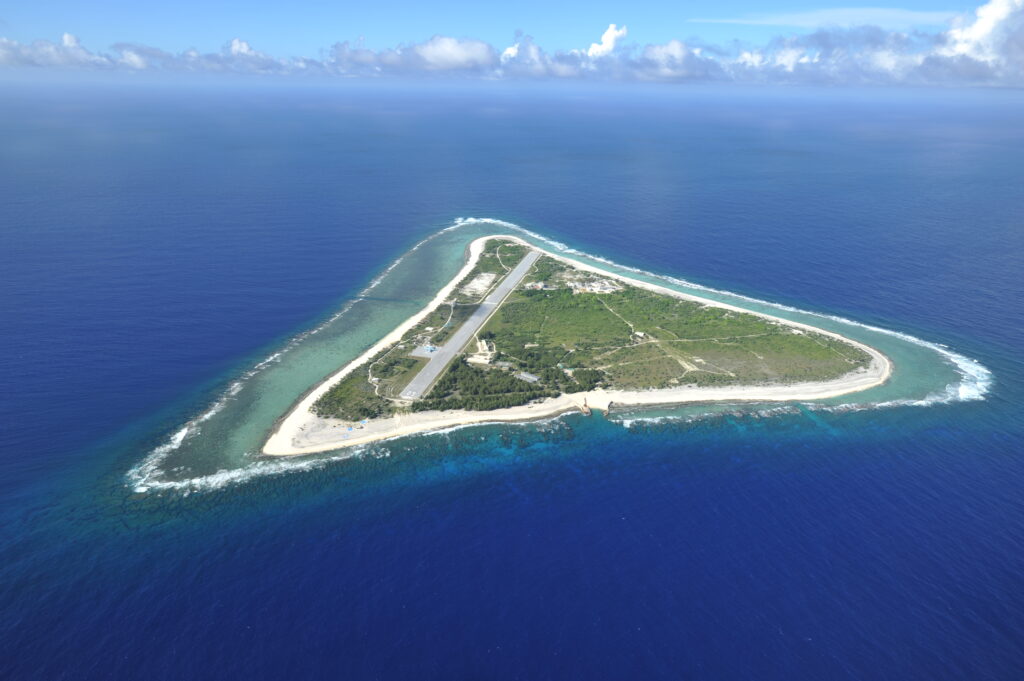
As mentioned above, the government’s request for a literature survey concerns Minami-Tori-shima specifically, among all the islands that make up Ogasawara Village. Minami-Tori-shima lies more than 1,000 kilometers (approximately 600 miles) from the inhabited islands of the Ogasawara archipelago—Chichi-jima and Haha-jima. While Minami-Tori-shima does have a permanent human presence, it is staffed exclusively by civil servants affiliated with organizations such as the Japan Maritime Self-Defense Force and the Japan Meteorological Agency, who carry out observation, monitoring, and airfield operations. No civilians reside on the island.
The government and METI have stated in their request letter that the island possesses favorable characteristics as indicated by Japan’s scientific feature map, which visualizes the suitability of locations across the country for a final disposal repository. At the same time, the absence of civilian residents and the fact that the entire island is state-owned land are widely understood to be key factors behind the government’s decision to move forward with this request.
The reasoning, in all likelihood, is that Minami-Tori-shima’s isolation from inhabited islands—and the prospect of the national government taking direct responsibility for final disposal there—makes it less likely to provoke strong opposition from Ogasawara Village residents or the Japanese public at large.
Mayor Shibuya of Ogasawara Village responded via the village’s official website with the following comment: “In response to this request, I intend to make my judgment while taking into account the views of village residents and the village council, including those expressed at public information sessions.”
Technology Needs and Expectations for Final Disposal
The topic of final disposal is, admittedly, not one with immediate business implications at this stage. That said, regardless of whether Minami-Tori-shima ultimately becomes the site for final disposal, any such project will require significant technological expertise from the private sector.
In the United States, for example, a startup called Deep Isolation is developing technology for storing radioactive waste in narrow boreholes deep underground—a distinct approach from conventional geological disposal methods. Closer to Japan, following the Fukushima Daiichi accident mentioned above, a number of Japanese companies, including startups, developed robots to support decommissioning operations at the plant.
Advancing such technologies and applying them to the challenge of final disposal will be essential to protecting the global environment for future generations.
At the same time, it is important to call on the Japanese government to communicate transparently with local communities and to put in place the necessary safeguards to prevent the theft or loss of radioactive waste. The latter concern is particularly serious: if radioactive material were to fall into the hands of terrorists or other bad actors and be combined with conventional explosives, it could be used to construct a crude but highly destructive weapon. Were that to happen, it would pose a grave threat not only to the people of Japan, but to the world at large.
While Minami-Tori-shima’s geographic isolation suggests that the risk of theft may be lower there than in other locations, robust risk management—including measures that address national security considerations—will nonetheless be essential.