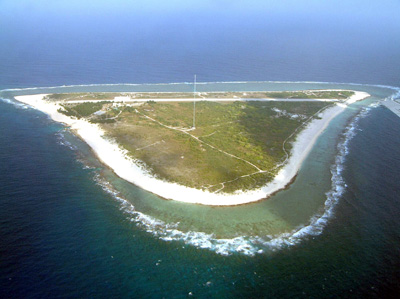
The Nuclear Waste Management Organization of Japan (NUMO) announced on May 20 that it has commenced a literature survey on the geological disposal of radioactive waste at Minami-Tori-Shima, an island in Ogasawara Village, Tokyo. This article traces the path that led to the launch of the survey.
Prior to this, Ryosei Akazawa, Minister of the Ministry of Economy, Trade and Industry (METI) — the ministry that oversees NUMO — had formally requested that Ogasawara Village Mayor Masaaki Shibuya accept a literature survey on March 3 of this year (see link below). The village subsequently agreed to the survey, leading to today’s announcement.

The Five Conditions the Mayor Put to the Government
Following Minister Akazawa’s request in March, NUMO held two rounds of community briefings each on Chichi-jima and Haha-jima — the inhabited islands of Ogasawara (Minami-Tori-Shima is also inhabited, but has no civilian residents) — as documented in NUMO’s records. Meeting minutes indicate that some residents voiced opposition.
On April 20, Mayor Shibuya formally responded to Minister Akazawa, indicating the village’s acceptance of the literature survey. The response document opens by stating: “As a premise, a society that does not rely on electricity is inconceivable, and nuclear power is considered a necessary source of electricity in the current situation” and “The author recognizes that this request is solely for the conduct of a literature survey, and does not constitute a decision to build a final disposal facility on Minami-Tori-Shima.” The document then sets out the following five conditions:
- Steadily advance research and development aimed at reducing the hazardousness and volume of radioactive waste.
- Since selecting a scientifically superior site requires surveys at a greater number of locations, the national government must take the lead in expanding the areas subject to literature surveys, rather than leaving the matter to individual communities.
- Establish dedicated forums organized by area of expertise and topic, invite specialists and engineers from relevant fields, and conduct thorough public outreach to deepen residents’ understanding.
- Widely disseminate accurate information — including the fact that Minami-Tori-Shima is located approximately 1,200 kilometers (approx. 750 miles) farther from Chichi-jima and Haha-jima than from the Japanese mainland — to prevent reputational damage.
- Make an explicit commitment that the literature survey does not directly lead to site selection for the disposal facility.
In response to these conditions, NUMO’s President Akira Yamaguchi (a nuclear engineering scholar) stated in the announcement of the survey’s launch: “We will work sincerely in coordination with the national government to address the conditions and other matters raised by Mayor Shibuya.” According to NUMO’s published records, the organization has held community dialogues at other literature survey sites and has provided public briefings beyond those sites.
As covered in the author’s previous article published in March, a literature survey is purely a process of reviewing existing data and documents to assess suitability as a final disposal site. As Mayor Shibuya’s conditions make clear, acceptance of the survey does not immediately make Minami-Tori-Shima a leading candidate for the facility.
That said, given the context that Minami-Tori-Shima is a place inhabited solely by government personnel — Maritime Self-Defense Force members, Japan Meteorological Agency staff, and other civil servants — it could be interpreted that the national government harbors particular expectations for the island.
Broad Public Communication: What Is Expected of the Government and NUMO
As Mayor Shibuya also noted in his response document, it is undeniable that nuclear power remains a practical energy source for Japan.
On the renewable energy front, large-scale solar farms have been opening across Japan in rapid succession, yet they have met with criticism from residents on the grounds of visual impact on the landscape. Japan also faces the underlying challenge of receiving comparatively fewer hours of sunshine than the global average. In the wind energy sector, it became news in August 2025 when Mitsubishi Corporation withdrew from offshore wind power generation, citing the difficulty of recouping its investment — more precisely, construction costs had more than doubled from the time of the original bid in 2021, making profitability unachievable.
Against this backdrop, nuclear power inevitably attracts expectations as a clean energy source. The 2011 Great East Japan Earthquake and the Fukushima Daiichi nuclear accident brought Japan’s nuclear power generation to a complete halt. While restarts have been proceeding gradually since then, nuclear power’s share of domestic electricity generation in fiscal year 2023 remained below ten percent. This means that even driving an electric vehicle, the energy powering it has in all likelihood been generated with the emission of carbon dioxide (CO2).
Nuclear power is of critical importance to Japan’s energy mix, yet the survey and selection of disposal sites naturally requires public understanding. Both the government and NUMO will be called upon to communicate broadly and thoroughly.
The development of Small Modular Reactors (SMRs) — a technology with potential to reduce radioactive waste — fusion power generation, which is in principle expected to produce no high-level radioactive waste, and power sources other than nuclear that are well-suited to Japan’s conditions are all topics that deserve consideration at the level of individual citizens.