

LOMBY, a developer of autonomous robots, announced on 28 September that it had closed a Series A funding round at the end of August, securing ¥387m ($2.4m).
Founded in 2022, the company is headquartered in Tokyo.
Robots for last-mile delivery from shops to consumers
Automated guided vehicles (AGVs) are already in use at workplaces such as factories and warehouses. LOMBY’s autonomous robots are similar to AGVs in that they can carry goods without a human operator, and the company does envisage deployment in factories, as well as in hospitals and commercial facilities. Yet the use case given top billing on the company’s website is last-mile delivery between retailers and consumers.
Since 2025, LOMBY’s robots have been delivering goods to consumers from several Seven-Eleven stores in Hachioji, Tokyo. Hachioji grew as a commuter town for central Tokyo, but parts of the city are ageing, and it is expected to become increasingly difficult to find delivery workers for logistics firms and food-delivery services. LOMBY is therefore running trials with Seven-Eleven in partnership with the Minami-Osawa Smart City Council, a local body promoting smart-city initiatives whose members include academics.
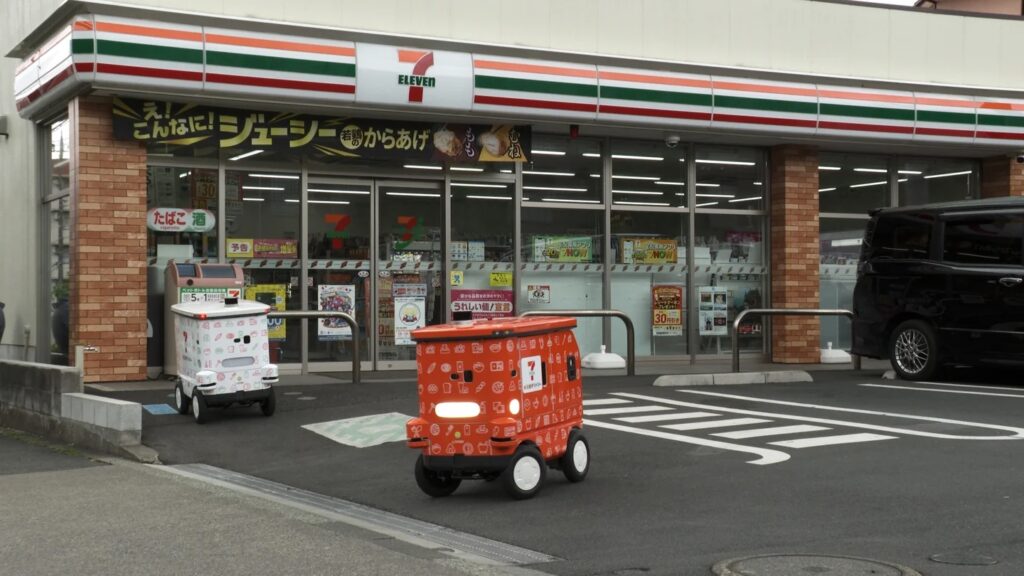
According to the specifications of LOMBY’s LM-A robot, its cargo space is split into front and rear compartments of roughly 47 litres (12 US gallons) and 65 litres (17 US gallons) respectively. The robot is electrically powered by a lithium-ion battery, and of its four wheels, the two at the rear provide drive. With a top speed of 6km/h (about 3.7mph), it travels on pavements and uses pedestrian crossings.
Funds to build mass-production capacity
The round was led by the fund manager Mercuria Investment, with participation from investors including Suzuki Motor and Nabtesco Technology Ventures, the corporate venture capital arm of the machinery maker Nabtesco.
The funds will be used for the following purposes:
- Expanding production of the LM-A autonomous delivery robot and building a mass-production system
- Concentrated deployment of robots in several locations across Japan (strengthening its partnership with Seven-Eleven)
- Enhancing its autonomous-driving AI and remote-monitoring operations
- Strengthening the organisation
Tomoharu Uchiyama, CEO of LOMBY, noted that ‘labour shortages have been a widely voiced concern in Japan’s super-ageing society in recent years, yet robots have still not become widespread on the country’s public roads’. He went on to say:
‘We believe that mobility that automates short-distance travel will play an increasingly important role in an ageing society.
‘With this funding, we will first establish mass production of the LM-A, a robot that moves goods freely within a local area, and create an environment in which anyone can easily use robots in their daily lives. Low-speed, compact robots are a field in which Japanese companies can aim to lead the world in the number of units in operation. We aim to spread them widely from Japan as domestically made robots.’