Reading the full series? Browse all volumes here.
Before diving in — Vol. 2 sets out the author’s framing and caveats.
Shinran, born the son of a minor noble
Shinran was born in 1173, the eldest son of Arinori Hino. The Hino were a family of minor nobles, but they could trace their lineage back to Kamatari Fujiwara and his son Fuhito. Kamatari Fujiwara was originally named Kamatari Nakatomi. In the 7th century, Kamatari joined forces with Prince Naka no Oe (later Emperor Tenji), a member of the imperial family, to overthrow the aristocratic Soga clan, and went on to lay the foundations of a centralised state.
Yet however illustrious his forebears, Shinran’s family belonged not to the main line of the Fujiwara clan but to the Hino, a cadet branch — and to a cadet branch within the Hino at that. On this basis, the religious historian Satoko Koyama observes that ‘even had Shinran lived as a nobleman, he would surely never have risen to high rank’.*¹
Moreover, Shinran and his four younger brothers all took holy orders at a young age. One might reason that if advancement as a nobleman was out of reach, a monk could at least make his way in the religious world. Even so, it is somewhat puzzling that not only Shinran but his brothers, too, entered the priesthood. The reason remains unclear.
Historical sources on Shinran are, in any case, extremely scarce. As an aside, they are so scarce that historians once went as far as to argue that Shinran never existed.*² That theory was refuted only in the 20th century, with the discovery of ten letters written by Shinran’s wife, Eshin-ni, to their daughter, Kakushin-ni.
After a retreat in a temple hall, Shinran becomes Honen’s disciple
Accordingly, those tracing Shinran’s early life tend to rely either on these letters (known as the Eshin-ni Monjo [Documents of Eshin-ni] or the Eshin-ni Shosoku [Letters of Eshin-ni]) or on the Shinran Shonin Den-e (Illustrated Biography of Saint Shinran, also known as the Honganji Shonin Den-e [Illustrated Biography of the Saint of Honganji]), a work attributed to Kaku-nyo. Kaku-nyo was a monk who was Shinran’s great-grandson and Kakushin-ni’s grandson. The Shinran Shonin Den-e, however, was partly intended to lend Shinran authority, and Koyama, cited above, points out that some of its content is ‘far removed from reality’.
The account of Shinran taking holy orders at the age of nine is a case in point. According to the Shinran Shonin Den-e, Shinran was ordained under Jien, who would later become Tendai Zasu. The Tendai Zasu is, in effect, the head of Tendai Shu. At the time of Shinran’s ordination, Jien had not yet become Tendai Zasu, but he had already established a considerable standing.*³ It is hard to imagine so eminent a monk involving himself in the ordination of a minor noble’s son, and one theory holds that the episode is an embellishment.
Be that as it may, if Shinran did take holy orders at nine, he spent the following 20 years, until the age of 29, on Mount Hiei as a monk of Tendai Shu. His descent from Mount Hiei is also mentioned in Shinran’s own work, the Ken Jodo Shinjitsu Kyogyosho Monrui (A Collection of Passages Revealing the True Teaching, Practice and Realisation of the Pure Land Way, commonly known as the Kyogyoshinsho). According to this work, he came down from the mountain in order to ‘cast aside miscellaneous practices and take refuge in the Primal Vow’.
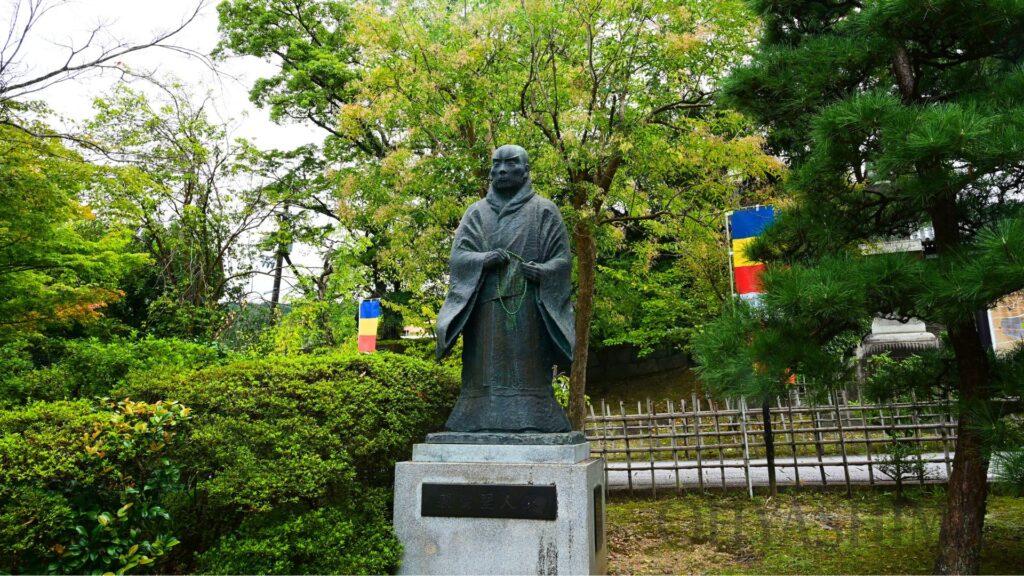
On Mount Hiei, Shinran held the status of doso. Doso were monks who pursued their religious practice, though some of them also rendered service at the various halls on the mountain.*⁴ It is thought that Shinran left Mount Hiei because he wished to devote himself to the Primal Vow of Amida Buddha rather than spend his time on such duties.
Shinran then shut himself away in Rokkakudo, a temple hall said to have been founded by Prince Shotoku, seeking a revelation from Guze Kannon Bosatsu, the World-Saving Bodhisattva Kannon (on Prince Shotoku, see Vol. 22). In religious belief, Prince Shotoku is regarded as an incarnation of Guze Kannon. Guze Kannon appeared to him in a dream at dawn on the 95th day of his retreat.
Having received the revelation in his dream, Shinran resolved to become Honen’s disciple. It is here that our story connects with the close of the previous instalment, which centred on Honen.
Yet the Guze Kannon of Shinran’s dream did not say a single word to the effect of ‘Go to Honen’. The document recording the dream, the Shinran Muki (Record of Shinran’s Dream),*⁵*⁶ says in essence ‘You shall make my vow heard by the multitudes’, and Honen’s name appears nowhere in it.
The author reads this as a sign that Honen had already won a certain renown by that time. From around 1189, Honen is said to have been frequently asked to perform prayer rituals by Kanezane Kujo, who served as sessho and kampaku. The sessho was the post of governing on the emperor’s behalf when he was ill or a child, among other circumstances, while the kampaku was the post of assisting the emperor.
In other words, Honen, who had left Mount Hiei and was active in what is now Kyoto, was so well known that his name had reached even the court. The author therefore believes that by 1201, when Shinran was praying at Rokkakudo and awaiting a revelation, he already knew of Honen.
OHYASHIMA is seeking information about the Ohmi Shonin
In connection with this series, OHYASHIMA welcomes information about the Ohmi Shonin. The author would be particularly grateful to hear from:
- Museum curators and archivists — in Japan or elsewhere — who hold collections related to the Ohmi Shonin
- Those who work for companies with ties to the Ohmi Shonin, or whose own ancestors were Ohmi Shonin
- Those who know of Ohmi Shonin merchants who conducted business outside Japan
OHYASHIMAは近江商人に関する情報を求めています
本連載にあたり、近江商人に関する情報を募集しています。たとえば、下記に該当する方はぜひご存じの情報をお寄せください。
- 日本国内外を問わず、近江商人に関する所蔵品がある博物館などの学芸員の方
- 近江商人と関連のある企業にお勤めの方、先祖などに近江商人がいらっしゃる方
- 日本国外でビジネスをした近江商人についてご存じの方
*¹ What Is Jodo Shinshu? Shinran’s Teaching and Its Lineage, Satoko Koyama, Chuko Shinsho
*² Why Is Jodo Shinshu the Largest School in Japan? The Riddle of Buddhist Schools, Hiromi Shimada, Gentosha Shinsho
*³‘The Life and Character of Jien, Author of the Gukansho: A Portrait of One of Medieval Japan’s Finest Monks [Figures in Japanese History]’, Serai.jp
*⁴‘The Life of Shinran Shonin (3)’, Shosenji
*⁵‘No. 480: The Life of Shinran Shonin as Told in the Illustrated Biography (11) — Volume 1, Section 3 (Part 3)’, Jufukuji Newsletter (the blog of Jufukuji, a temple of the Honganji branch of Jodo Shinshu in Yamaguchi Prefecture; note that the URL begins with ‘http’, not ‘https’)
*⁶‘Dharma Talk, April 2021 (Reiwa 3)’, Jokyoji