
East Japan Railway Company (JR East) announced on June 9 a QR-code ticket that it will introduce from spring 2027. The new tickets will be larger than the current ones, making them easier to hold up to a reader.
JR East is a railway operator whose principal service area covers the Kanto region—including Tokyo—and the Tohoku region, and which runs lines such as the Tohoku and Joetsu shinkansen.
Eight Tokyo-area railway operators, including JR East, to adopt QR-code tickets
The QR-code tickets to be introduced next spring will be limited to short-distance tickets. In the JR Group’s case, short-distance tickets are those covering distances of under 101 operating kilometers (about 63 miles).
Conventional short-distance tickets relied on reading magnetic data carried on the ticket. Recycling such tickets, however, required separating out the magnetic layer, which placed a burden on the environment. The new tickets are intended to ease that burden.
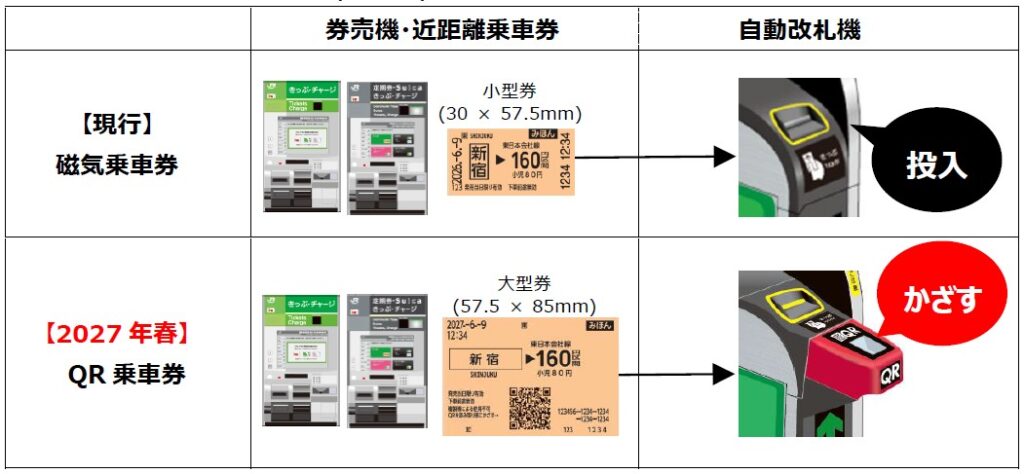
The replacement of magnetic tickets with QR-code tickets had already been announced jointly in May 2024 by eight Tokyo-area railway operators, including JR East (the figure as of the announcement; the number now stands at seven following a merger). Among the operators other than JR East are Keisei Electric Railway (which runs a line linking central Tokyo and Narita International Airport), Keikyu Corporation (which runs a line linking central Tokyo and Haneda Airport) and Tokyo Monorail (likewise). They have set the end of fiscal 2026—that is, spring 2027 or later—as the timing for the switchover.
JR East also announced that, alongside the new tickets, it intends to introduce an AI-assisted version of its Midori-no-Madoguchi staffed ticket counters (a tentative name), and that it will run a proof-of-concept trial in July at Tachikawa Station in Tokyo and Omiya Station in Saitama.
In Japan, as elsewhere, contactless methods dominate public transit
Even with the new paper tickets, an estimated 90 to 95 percent of JR East’s passengers are said to use Suica. Suica is a form of NFC-based payment offered by JR East.
Globally, too, contactless payment has already become the mainstream for entering and paying on public transit.
Accordingly, it seems unlikely that QR-code paper tickets will see much use at JR East, either.