
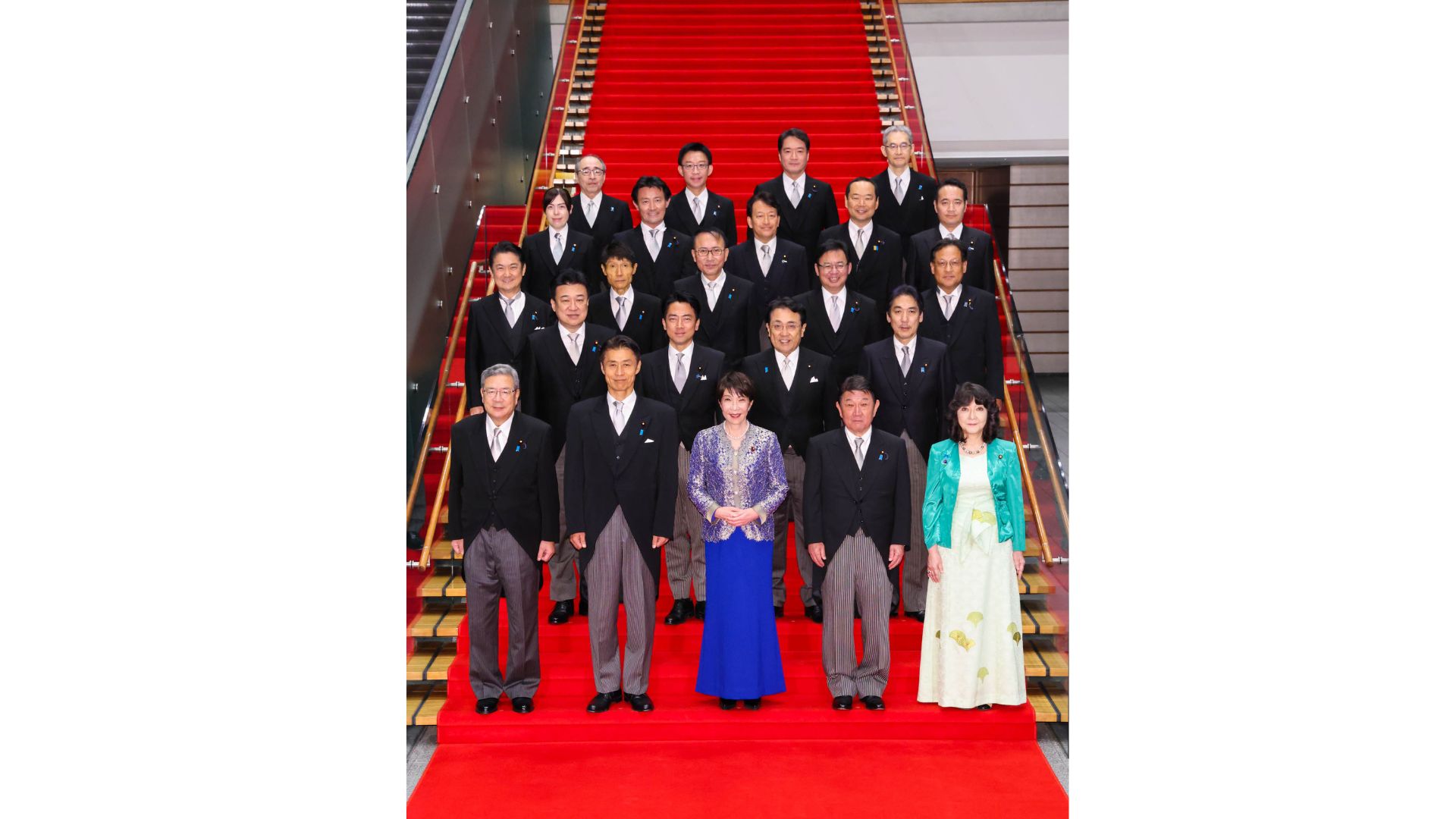
On 17 September, the reshuffled second Takaichi Cabinet took office. The same day, the cabinet approved its basic policy — the prime minister’s instructions to her ministers. Today we work through that document, focusing on the items that bear on the economy.

A stated direction of travel on the debt ratio
The instructions are built around four pillars: 1. economic and fiscal management grounded in the idea of a “responsible proactive fiscal policy”; 2. protecting the lives and livelihoods of the public; 3. strengthening diplomatic and defence capabilities; and 4. improving how policy is communicated.
Read through in full, the line that catches the eye first sits in the section on economic and fiscal management. By lifting Japan’s potential growth rate, raising employment and incomes, improving consumer sentiment and pushing business earnings and tax revenues onto a naturally rising path, the government says it will deliver a virtuous cycle under an expanding GDP — and in doing so “bring the debt-to-GDP ratio down on a stable basis, reconciling strong growth in the Japanese economy with fiscal sustainability”.
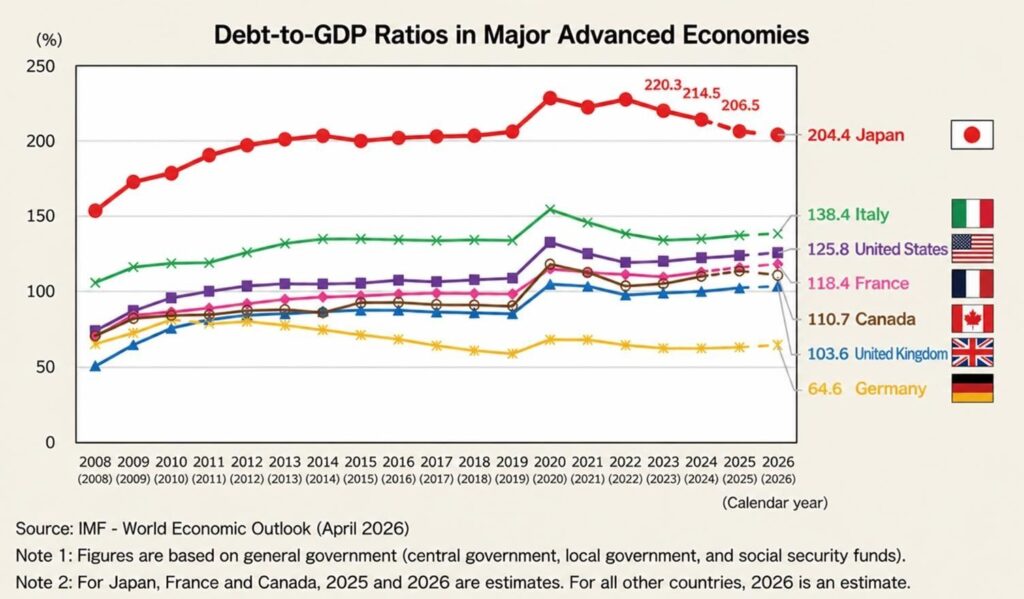
Prime Minister Sanae Takaichi has run on a “responsible proactive fiscal policy” since taking office. Yet on 1 September the yield on the benchmark 10-year Japanese government bond rose above 3% for the first time in roughly 30 years, and unease about the public finances persists in the market. Spelling out a commitment to lowering the debt-to-GDP ratio can therefore be read as a signal to investors about where this administration stands. The Ministry of Finance puts the estimated debt-to-GDP ratio for 2026 at 204.4%, conspicuously high by G7 standards. Whether the debt-to-GDP ratio is a sound gauge of fiscal health is itself contested. But so long as the market treats the sheer size of the outstanding debt as a risk factor, the government presumably had little choice but to commit to improving it.
Separately, subject to a vote in the extraordinary session of the Diet that convenes in October, the consumption tax on food will be cut to 1% for two years from April 2027. On this the instructions say the government will “pursue integrated reform of taxation and social security, including a temporary reduction in the consumption tax rate on food and drink and the introduction of a support payment to ease the burden on working people, informed by the discussions of the National Council on Social Security”.

Japan’s disasters are growing harsher
The second pillar is “protecting the lives and livelihoods of the public”, and the first thing listed under it is disasters. With 2026 drawing towards its close, this has felt like a year of more disasters than usual for Japan. Kumamoto Prefecture, home among other things to TSMC’s plant, was struck by an earthquake that registered a seismic intensity of 7 — the top of the Japan Meteorological Agency’s scale; Kikuyo, where TSMC sits, recorded an upper 5. In August, flooding caused damage in Chiba Prefecture, which borders Tokyo, and in the Hokuriku region.
This writer has relatives in Chiba. They were unhurt and their house escaped damage, but their car was submerged and they ended up having to buy a new one.
There is scope here for companies too: those offering useful tools for disaster preparedness and for the moments when disaster strikes, and — taking a wider view — those whose technologies help address climate change.
The following paragraph, meanwhile, commits the government to realising “a society of well-ordered and harmonious coexistence with foreign nationals” by responding firmly to problematic conduct. This is not written to defend the Takaichi administration or the government. The point is narrower: foreign nationals who commit crimes and the like will be dealt with “firmly”. As we noted when the February instructions were issued, it is true that, as in Europe, parties advancing arguments that can read as xenophobic have gained ground in Japan. They have not, however, come close to forming a majority in national or local politics. As in other countries, the Japanese public worries about the downsides of globalisation — but the fact that no mood of excluding foreign nationals wholesale has taken hold is telling. For readers who are serious about building business with Japanese companies and Japanese people as partners or customers, that should be reassuring, at least for now.
The second pillar also touches the economy through that word “livelihoods”. The instructions state that, led by the minister in charge of economic security, the government will conduct supply-chain surveys on an ongoing basis and build an economic structure resilient to currency swings and to economic coercion. Easing the market unease described above looks likely to be one of the means to that end.