
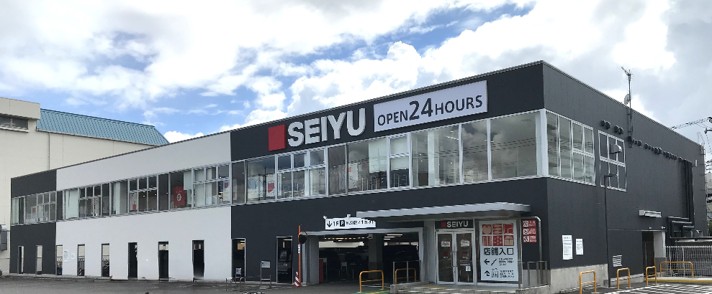
Trial Holdings, which operates discount stores and other retail outlets in Japan, announced on 21 August that it would monetise the property held by its subsidiary Seiyu. Seiyu was originally a general merchandise store (GMS) belonging to the Saison Group and, after passing through a succession of parent companies including Walmart, was acquired by Trial in 2025.
Part of the property Seiyu holds across Japan, its stores among it, will be sold, while Seiyu itself carries on trading as a GMS from the same premises under a leaseback arrangement. For Trial, whose debt rose with the Seiyu acquisition, the aim is to secure credit headroom and improve its financial position.
Those are the facts. What I want to set down here is what Seiyu means to me as a shop, and some loose reflections on where Japan’s GMS are heading.
Seiyu and me
The GMS closest to the house where I spent my boyhood was a Seiyu (there was an Ito-Yokado nearby, too). It is, in other words, a GMS I know very well.
A digression, straight away. My mother tells me that when she went to that Seiyu, a restaurant run by Yoko Gushiken, the former WBA junior flyweight boxing champion, had opened there. (A ramen shop or an Okinawa soba shop, I think; there is no Gushiken restaurant anywhere in my own memory of that Seiyu.) As she stood looking at it, thinking that it was Gushiken’s place, the man himself came out with a delighted look on his face and welcomed her in. Why Gushiken had a restaurant in the Seiyu near my home I cannot say, since that branch itself closed a long time ago.
There is also a Seiyu near where I live now: one stop on the underground, and close enough to walk.
After Trial’s acquisition, it was decided that this branch would be refurbished. It will close temporarily this autumn and reopen for business in winter. The building has two floors above ground and one below, and the second-floor space, which sold electronics and clothing, had already been closed off by early summer.
That Seiyu, though, was not originally built as a GMS, and I am told it was completed in the 1960s.
Surviving on thin margins
This is only one example, but when I think about the facilities, about the business itself, and about the infrastructure people need to reach the stores, I find myself wondering whether Japan’s GMS can carry on trading. In the case of the Seiyu near me, I understand perfectly well that Trial cannot simply rebuild. As noted above, the company laid out a large sum on the acquisition (¥380bn, about $2.39bn at current rates), and the thinking must be to go on using any store that can be used without rebuilding. There may also be the fact that, as a store in central Tokyo, new construction would be difficult out of consideration for the surrounding environment.
When I consider the outlook for Japan’s GMS industry, though, I am uneasy. Even at Aeon, the largest operator, much of the profit comes from finance and property (rent from the tenants that occupy space alongside Aeon, among other sources). GMS margins, in other words, are thin. Seven & i Holdings, which used to have the aforementioned Ito-Yokado under its wing, was pressed by ValueAct Capital Management, then a shareholder, to separate Ito-Yokado, and in the end matters proceeded exactly as the fund had demanded.
There is a further concern: that with a shortage of workers brought on by rapid ageing and a falling birth rate, Japan may no longer be able to keep up with building and repairing its infrastructure. Beyond the store buildings themselves, then, I fear a time may come when, depending on the region, simply getting to a GMS is a struggle.
That is precisely why, as a consumer, I want the GMS to survive. In regional Japan especially, they serve as important infrastructure. And this is something I would like business people outside Japan, particularly those in the financial industry, to know.