
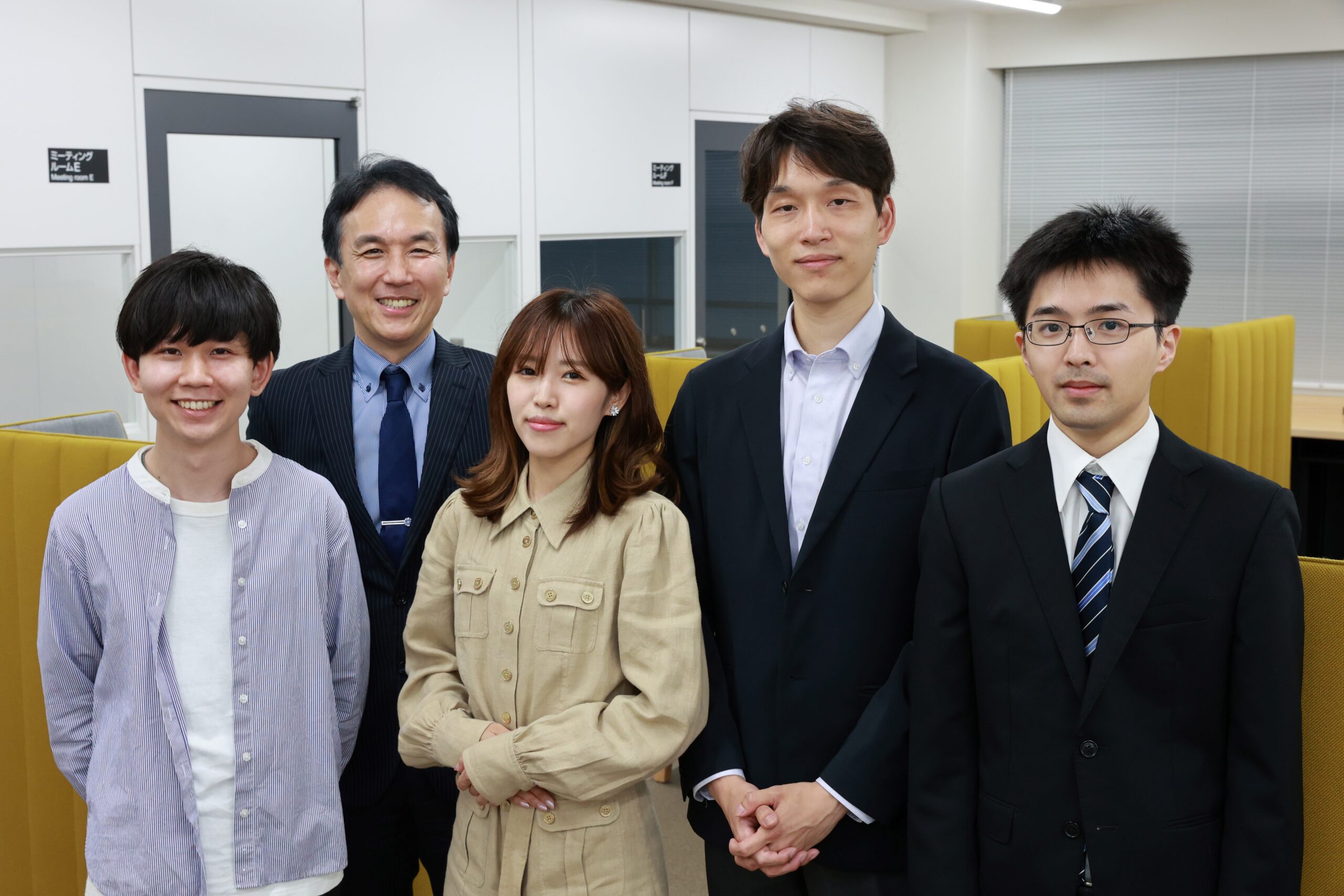
cosmobloom, which designs and develops space structures, announced on 7 August that it had secured ¥330 million (about $2 million) in a seed funding round.
The company was founded in 2023 by CEO Momoko Fukunaga and CIO (Chief Information Officer) Hiroyuki Ono, among others, who came out of the Miyazaki Laboratory of the Department of Aerospace Engineering, College of Science and Technology, Nihon University (now the Space Structures Systems Laboratory of the Japan Aerospace Exploration Agency (JAXA)). It is headquartered in Tokyo.
A space-debris countermeasure device built on software development technology
At present, rockets are the only means of carrying objects into space. Spaceplanes are under development, but it will be a long time before large transport craft — of the kind operated by aircraft manufacturers or the air forces of major powers — can be used in space as well.
This is where the gossamer structure comes in when building any kind of structure in space. It is a structure, and a technology, in which flexible members such as membranes and cables are wound around a hub, loaded onto a rocket and then deployed once space is reached.
Deploying an object stowed as a gossamer structure correctly in space — an environment vastly different from Earth — is, however, difficult. The analysis code (software) developed by the aforementioned Miyazaki Laboratory to solve this challenge is “NEDA (Nonlinear Elasto-Dynamic Analysis code)”. It can simulate the deployment of a structure while satisfying three principles — the energy, momentum and angular-momentum principles. With conventional calculation methods, errors and approximations could arise during the simulation, producing results that violated the laws of physical conservation. NEDA is the solution to this. In 2025, cosmobloom announced that it would jointly develop membrane structures and membrane antennas with several Japanese companies. In April this year, it also announced that it had completed development of “LEAF (Lightweight Expandable Aerobraking Film)”, a device for removing small satellites from orbit. A small satellite bound for low Earth orbit (LEO) is fitted with LEAF in advance; once its operational life ends, the membrane inside the device is deployed, generating air resistance that pulls the satellite out of orbit. It is designed to comply with a rule set by the US Federal Communications Commission (FCC) requiring, as a space-debris measure, that satellites in LEO be de-orbited within five years of completing their mission.
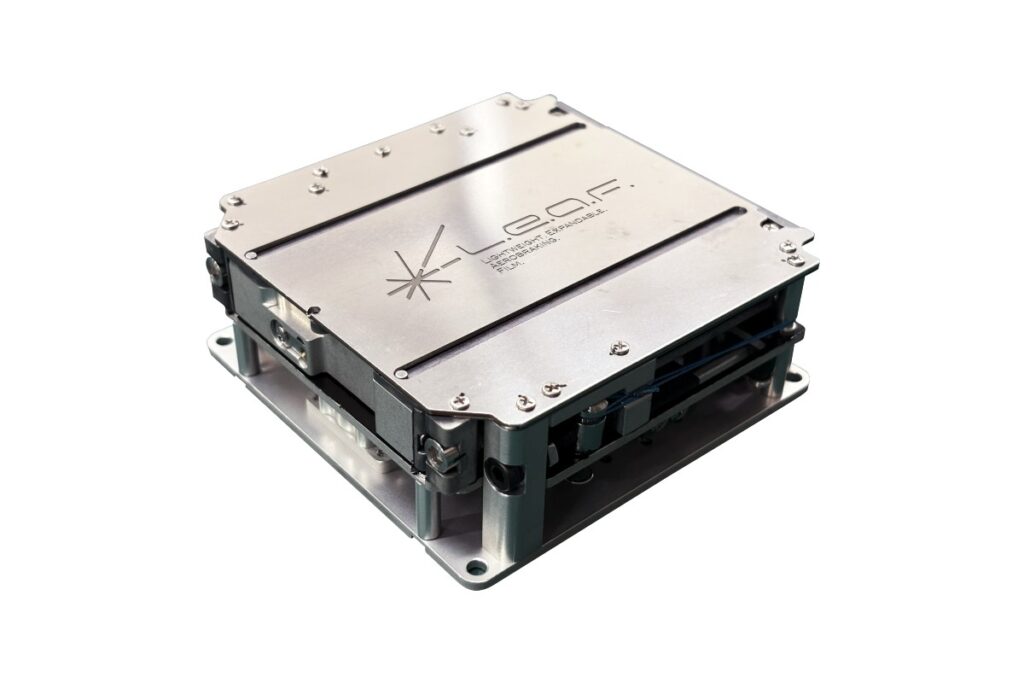
LEAF is due to undergo an in-space demonstration this winter.
Funds to be used for developing structures
The seed round drew participation from Toyota Invention Partners, Sega Sammy Holdings and Taiyo Kogyo, among others. Taiyo Kogyo is a manufacturer of large membrane structures and is the company with which cosmobloom, mentioned above, is jointly developing membrane structures.
As for the use of the funds, the company says it will “advance the development of metre-class membrane antennas that enable direct communication with devices such as mobile phones and PCs, as well as thin-film solar-cell paddles for high-power spacecraft such as space data centres”.
Fukunaga, cosmobloom’s CEO, commented: “We will advance our technology to the next stage — on-orbit demonstration — while accelerating growth on both the business and organisational fronts.”