

PXP, a developer of chalcopyrite solar cells, announced on 9 July that it had raised ¥1.56bn (about $9.6m) in a Series B funding round. Of that, ¥900m (about $5.5m) was raised as debt.
The company was founded in 2020, largely by former staff of Solar Frontier, a Japanese solar-cell maker. It is headquartered in Sagamihara, Kanagawa Prefecture.
How chalcopyrite cells differ from the old CIS cells
Solar power has become one of the mainstays of renewable energy, but conventional cells are heavy and flat, which limits where they can be installed. In practice, that means locations with a high load-bearing capacity and a flat surface, such as roofs and rooftops.
The breakthrough being pursued to overcome this is the thin, lightweight and flexible solar cell. The best known of these is probably the perovskite cell.
PXP, by contrast, is developing the chalcopyrite cell. Formerly known as the “CIS cell”, it uses copper and indium, among other materials. As noted, Solar Frontier once withdrew from the manufacture and sale of glass-substrate CIS cells. Wanting to shed that image through the name, and to signal the high flexibility afforded by a titanium-foil substrate, the company settled on the term “chalcopyrite cell”, as PXP’s president, Satoru Kuriyagawa, has told the media. Kuriyagawa, too, is a Solar Frontier Solar Frontier alumnus.
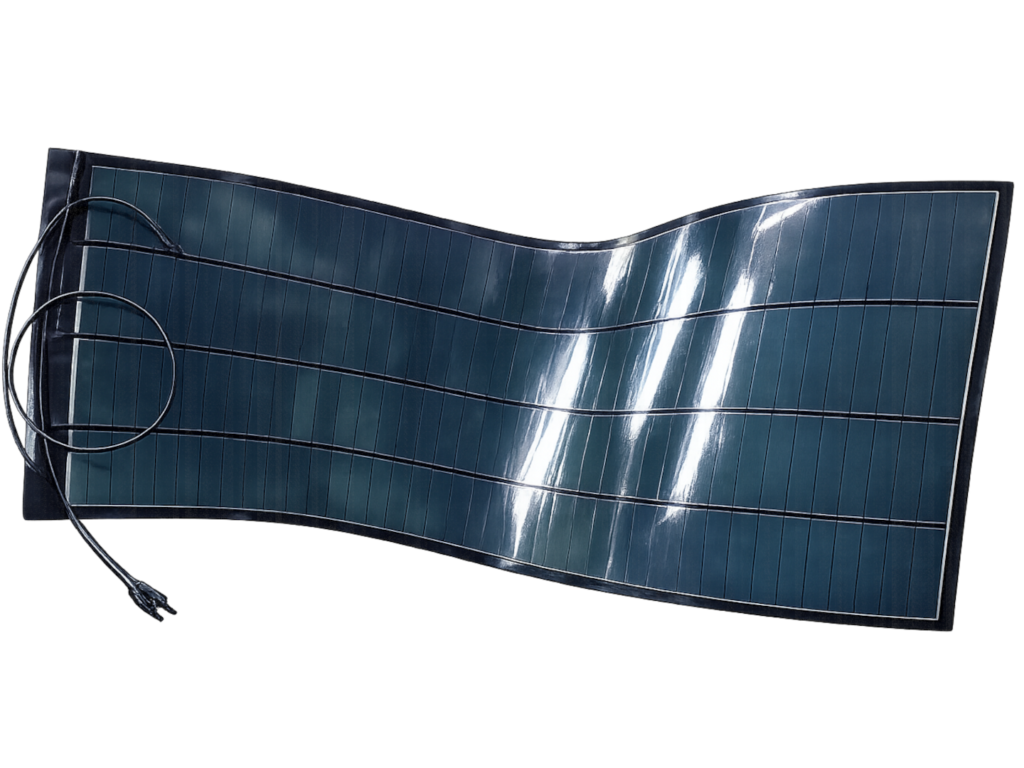
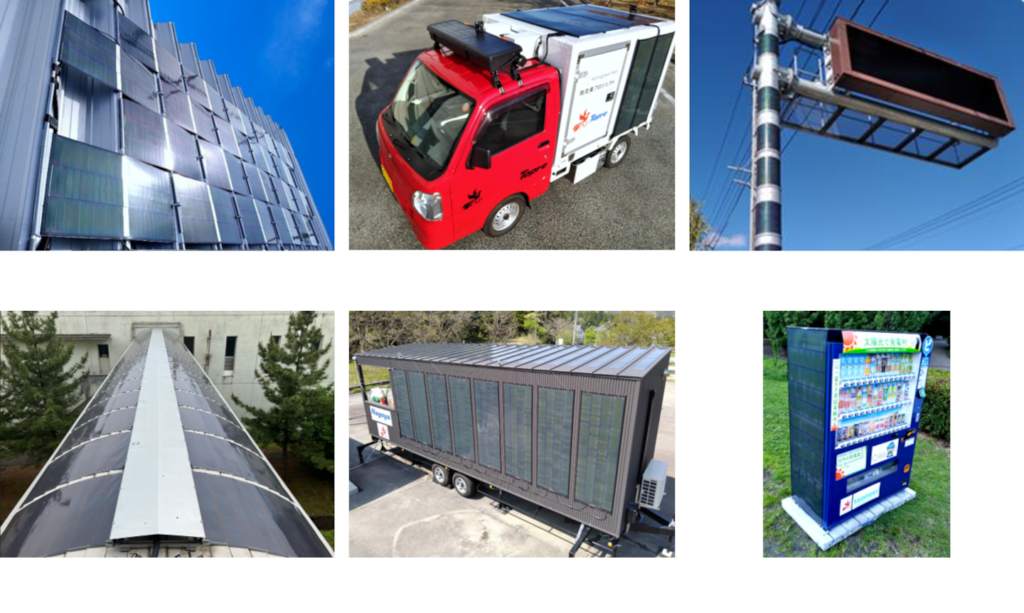
Because PXP already has members who have taken such cells through development, its demonstration work has progressed to a degree. As the photographs below show, the cells have been fitted in places where conventional panels could not be installed, such as the walls and curved surfaces of buildings and the poles of roadside information displays. The same photographs show cells mounted on a vehicle; used in this way, the company says, they can reduce the electricity consumed in charging the vehicle from the grid.
There is, however, a countervailing reality: Japan’s Ministry of Economy, Trade and Industry (METI) is concentrating its efforts on perovskite cells.
PXP is also pointing towards making use of perovskite cells. It is exploring a tandem structure combining chalcopyrite and perovskite, with the aim of raising conversion efficiency by capturing sunlight across a wider range of wavelengths.
Funds to go towards the factory under construction
On the equity side of the Series B, SoftBank, PXP’s largest shareholder, invested again. Also taking part were Nagoya Electric Works, a maker of roadside information displays, and ShinMaywa Industries, a maker of transport and industrial equipment, among others.
The money will fund capital investment in a mass-production factory now under construction. Located in Sagamihara, the same city as PXP’s headquarters, the plant is due to begin operating in the 2027 financial year (April 2027 to March 2028). According to the announcement, it will have an annual production capacity of 25 megawatts.