In December 2025, the White House released the 2025 edition of its National Security Strategy (NSS).
From the perspective of Japan’s economy, one particularly noteworthy aspect of this NSS is the absence of any explicit reference to North Korea (the Democratic People’s Republic of Korea). Paradoxically, this lack of mention could itself increase certain security risks for Japan. At the same time, a broader reading of NSS 2025 also reveals developments that could work to Japan’s advantage.
This article examines the relationship between the NSS and Japan’s economy.
The Risks of North Korea Being “Unmentioned” in NSS 2025
How does the absence of references to North Korea in NSS 2025 translate into risks for Japan? To answer this question, it is first necessary to review the bilateral relationship between Japan and North Korea.
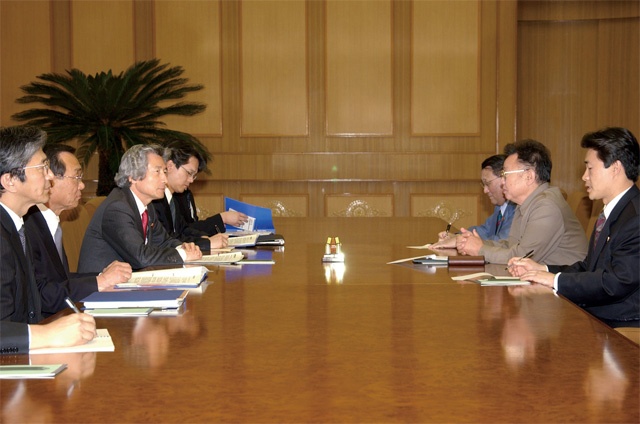
Japan and North Korea do not maintain diplomatic relations. However, during two Japan–North Korea summit meetings held in the early 2000s, both sides confirmed their intention to address outstanding issues with a view toward normalizing relations.
Among these issues, the most significant have been the abduction issue and the nuclear and missile issue.
The abduction issue refers to a series of incidents in which Japanese citizens were abducted by North Korean operatives, reportedly for the purpose of training intelligence personnel or acquiring specific skills. The Japanese government officially recognizes 17 abductees, five of whom have since returned to Japan, while acknowledging that there are many other individuals who disappeared under suspicious circumstances and may also have been abducted.
The nuclear and missile issue concerns North Korea’s development of nuclear weapons and the missiles intended to deliver them. North Korea is believed to have pursued nuclear development since the 1990s. During the first North Korean nuclear crisis in 1994, when tensions escalated sharply, the Clinton administration reportedly considered a military strike on North Korea’s nuclear facilities, and information to that effect was said to have been shared with the Japanese government and relevant local authorities.
In addition, views have increasingly emerged among governments and scholars that North Korea may already have reached a stage at which nuclear weapons could be mounted on missile warheads. With regard to missiles, analyses by Japan and other neighboring governments indicate that North Korea has developed not only ballistic missiles but also missiles capable of flying along irregular or maneuvering trajectories.
From Japan’s perspective, the relationship with North Korea can thus be characterized as one in which Japan has suffered incalculable harm through the abduction of its citizens, while simultaneously living under a persistent threat. During the Cuban Missile Crisis, the situation was described as “a gun being pointed at the U.S. mainland.” Japan, in effect, has lived under comparable conditions for roughly three decades.
For North Korea, nuclear weapons have also served as a powerful tool beyond their military function—namely, as diplomatic leverage.
To put this into economic context, North Korea’s GDP has in recent years been estimated at around $26 billion. By contrast, South Korea—a state formed by the same Korean people but operating as a liberal democracy—has a GDP of roughly $2 trillion.
Despite its extremely limited economic scale, North Korea has been able to engage in negotiations with the United States on something approaching equal footing due to its nuclear capabilities. Many readers will recall the summit meetings between U.S. President Donald Trump and Kim Jong-un, Chairman of North Korea’s State Affairs Commission.
In the latest NSS, however, references to North Korea have disappeared. As a result, there is a possibility that being effectively passed over by the United States—despite having previously negotiated on relatively equal terms—could prompt North Korea to adopt more extreme brinkmanship tactics.
That said, this does not mean that Japan’s security risk stemming from North Korea has suddenly increased. Rather, it is more appropriate to view this as one of the many variables shaping Japan’s overall security risk profile having moved upward.
North Korea continues to regularly launch missiles toward the Sea of Japan. Nevertheless, it would be difficult to argue that the absence of references in the NSS alone would lead North Korea to carry out direct attacks on Japan or neighboring countries. Future risk shifts are more likely to occur when this factor interacts with other changing variables.
Accordingly, the security risk stemming from North Korea that readers outside Japan should be aware of is, first and foremost, the existence of nuclear and missile capabilities. At present, however, the likelihood of those capabilities being used in actual military action cannot be described as particularly high.
Surprisingly “Cooperative” Language Toward East Asian Allies
What, then, can be seen as a positive sign for Japan in NSS 2025?
Several passages in the section on China policy offer important clues.
“Importantly, this must be accompanied by a robust and ongoing focus on deterrence to prevent war in the Indo-Pacific.”
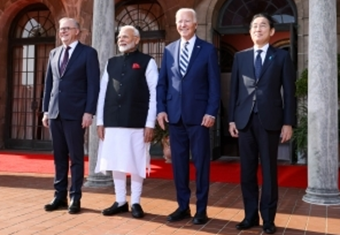
“We must continue to improve commercial (and other) relations with India to encourage New Delhi to contribute to Indo-Pacific security, including through continued quadrilateral cooperation with Australia, Japan, and the United States (‘the Quad’). Moreover, we will also work to align the actions of our allies and partners with our joint interest in preventing domination by any single competitor nation.”
“We must encourage Europe, Japan, Korea, Australia, Canada, Mexico, and other prominent nations in adopting trade policies that help rebalance China’s economy toward household consumption, because Southeast Asia, Latin America, and the Middle East cannot alone absorb China’s enormous excess capacity.”
“This will require not just further investment in our military—especially naval—capabilities, but also strong cooperation with every nation that stands to suffer, from India to Japan and beyond, if this problem is not addressed.”
Given President Trump’s emphasis on “America First,” this language appears notably cooperative. The NSS also states, with regard to Taiwan, that “We will also maintain our longstanding declaratory policy on Taiwan, meaning that the United States does not support any unilateral change to the status quo in the Taiwan Strait,” underscoring Washington’s continued commitment to stability across the Taiwan Strait.
However, this should not be interpreted too optimistically.
The NSS includes language such as, “Given President Trump’s insistence on increased burden-sharing from Japan and South Korea,” and other passages that can be read as encouraging allies to contribute more to the U.S. economy. As in the past, it is highly likely that President Trump will continue to demand various forms of burden-sharing from Japan and other allies, both in defense and economic terms. There will almost certainly be occasions when the Japanese government must bear additional costs, with potential negative effects on the economy.
It is also noteworthy that the regional section of NSS 2025 begins with the Western Hemisphere. Indeed, shortly after the release of the NSS, the U.S. government detained Venezuelan President Nicolás Maduro, which could be interpreted as a sign that East Asia ranks lower in priority than the Western Hemisphere.
Even so, it can reasonably be understood that the White House recognizes the need to remain committed to the defense of East Asia—including Japan—in order to sustain U.S. global presence.
A Traditionally Inward-Looking Japan Becoming a Hub of Globalism
Finally, it is worth briefly considering Japan’s economy from an international perspective beyond what can be gleaned from NSS 2025 alone.
As a Japanese national, the author holds mixed feelings, but it is a fact that Japan remains dependent on the United States in both defense and economic terms. In the first half of 2025, when President Trump announced new tariffs on various countries, Japan—particularly its business community—reacted with considerable alarm.
At the same time, in response to the second Trump administration and the relative decline of U.S. global presence, the Japanese government has sought to build an economic environment that is not overly dependent on the United States. Several examples illustrate this effort.
The Trans-Pacific Partnership (TPP), originally promoted by countries in North America and Oceania including the United States, saw the U.S. withdraw following the inauguration of the first Trump administration. In the aftermath, Japan’s presence within the framework grew significantly.
In 2023, the United Kingdom joined the TPP. Japan has also concluded an Economic Partnership Agreement (EPA) with the European Union and has maintained partnerships with ASEAN from an early stage.
At the risk of digressing slightly, the author does not consider Japan to be a country that has fully embraced globalization. Moreover, as seen in the U.S. withdrawal from the TPP, global multipolarization is advancing.
Nevertheless, Japan has built economic relationships with a wide range of regions and has managed to sustain them even amid this multipolar trend. As a result, Japan is increasingly taking on the role of a hub within the global economic system.
China, of course, wields far greater capital power than Japan and is actively promoting multilateral economic cooperation. Japan’s key advantage, however, lies in the fact that it has remained a liberal democracy for the 80 years since the end of World War II. This continuity is likely to resonate strongly with businesspeople in other liberal democratic countries who value shared principles and trust.