
Oceanic Constellations, a Japanese startup developing unmanned surface vehicles (USVs), announced on February 12 that it has secured approximately ¥2 billion (around $13 million) in a Series B1 funding round.
Founded in 2023, the company is headquartered in Kamakura, Kanagawa Prefecture.
Envisioned Use Cases for USVs Include Disaster Prevention, Anti-Poaching Surveillance, and Marine Resource Exploration
Oceanic Constellations develops both the hardware and software for unmanned surface vehicles (USVs). The company positions its USVs as “artificial satellites on the sea,” operating them in coordinated fleets to conduct Earth observation and related monitoring.
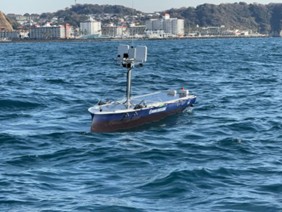
Rather than simply deploying USVs on the ocean surface and collecting data via communications, the company also generates virtual USVs that accompany physical ones. Through this hybrid operation, combining real and virtual assets, the company says it can enhance the realism of marine environment simulations.
The company was founded by co-CEOs Saneaki Obata and Takuma Honda. Obata is the founder of Xebral, a company specializing in public-sector data analysis. Honda previously launched satellite-related businesses at Mitsui & Co.
According to the company’s website, Oceanic Constellations was established when Obata’s recognition that ocean data remains one of humanity’s largely unexplored domains converged with Honda’s sense that satellite-based Earth observation alone has inherent limitations.
In August 2025, the company successfully conducted a continuous 12-hour nighttime USV operation. This demonstration was aimed at future nighttime surveillance of illegal fishing and also aligns with one of the company’s technical goals: the development of a “maintenance-free system” This term refers to a design concept that combines durability and autonomous power management, enabling long-term deployment at sea without maintenance.
In January 2026, Oceanic Constellations signed a memorandum of understanding with Nippon Yusen (NYK Line) regarding the offshore recovery of reusable rockets. NYK Line also joined the Series B1 round as a new investor.
In addition to these applications, the company cites maritime monitoring for disaster prevention and marine resource surveys as key use cases for its USV technology.
Series B1 Funding Marks a Shift from Demonstration to Practical Deployment
The Series B1 round was led by existing investor GLOBIS Capital Partners and new investor JAFCO Group, with participation from NYK Line and several other venture capital firms.
While the company did not disclose details regarding the use of funds or comments from management, the press release stated that the strong evaluation and high expectations reflected in this funding round stem from recognition of the company’s progress as it transitions from the demonstration phase to practical deployment.