

Albatross Technology, which develops vertical-axis wind turbines for floating offshore wind power, announced on September 9 that it had secured 250 million yen (approximately $1.6 million) in a pre-Series B funding round.
The company was founded in 2012 as a limited liability company and reorganized as a joint-stock company in 2022. It is headquartered in Tokyo.
Japan’s wind sector is under strain, and Albatross Technology’s technology
In the Seventh Strategic Energy Plan, adopted in 2025, the Japanese government projects that renewables will account for roughly half of the 1.1 trillion to 1.2 trillion kilowatt-hours of electricity Japan is expected to generate in fiscal 2040. Its carbon neutrality commitments are, of course, reflected in that figure. For wind power, the plan projects a share of 4 to 8 percent of total generation in the same fiscal year.
The current state of wind power in Japan, however, is difficult. To begin with, wind accounted for a mere 1.1 percent of total generation in fiscal 2023. Some countries are better suited to wind than others, but given that the government has set out to roughly double the renewable share between now and fiscal 2040, and to raise wind generation on top of that, the sector will have to build a far larger presence than it has today.
A second event that came to symbolize the difficulty facing wind power, and offshore wind in particular, was Mitsubishi Corporation’s withdrawal from the sector. A consortium led by the company had been developing offshore wind projects in three sea areas in Japan, and in August 2025 it pulled out of all three, citing deteriorating economics.
Which brings us to today’s subject, Albatross Technology, a startup developing, as noted above, vertical-axis wind turbines for floating offshore wind. In floating offshore wind, anchors are set into the seabed and connected by wire to the turbine assembly floating at the surface.
Albatross Technology cites not spoiling the view as one advantage of floating offshore wind. Bottom-fixed turbines, which are structurally much like onshore wind turbines transplanted offshore, require a tower driven into the seabed, which makes installation difficult outside relatively shallow water. In Japan, solar farms proliferated after the 2011 Fukushima Daiichi nuclear accident, and some members of the public say the panels have spoiled local scenery. The possibility of similar friction over wind power cannot be ruled out. Floating turbines, however, can be installed in deeper water than bottom-fixed ones, which means they can be sited at a distance from the coast. That makes them easier to keep out of sight than bottom-fixed turbines.
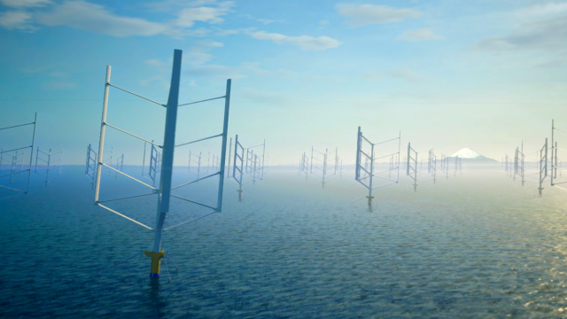
The turbines Albatross Technology is developing have a rotational axis that runs roughly vertical. The company calls the design FAWT, short for Floating Axis Wind Turbine. A FAWT allows the float that forms the main body of a floating offshore wind installation to be made smaller, lighter and lower in its center of gravity. According to Albatross Technology, this translates into lower costs and a float that will not capsize in severe storms.
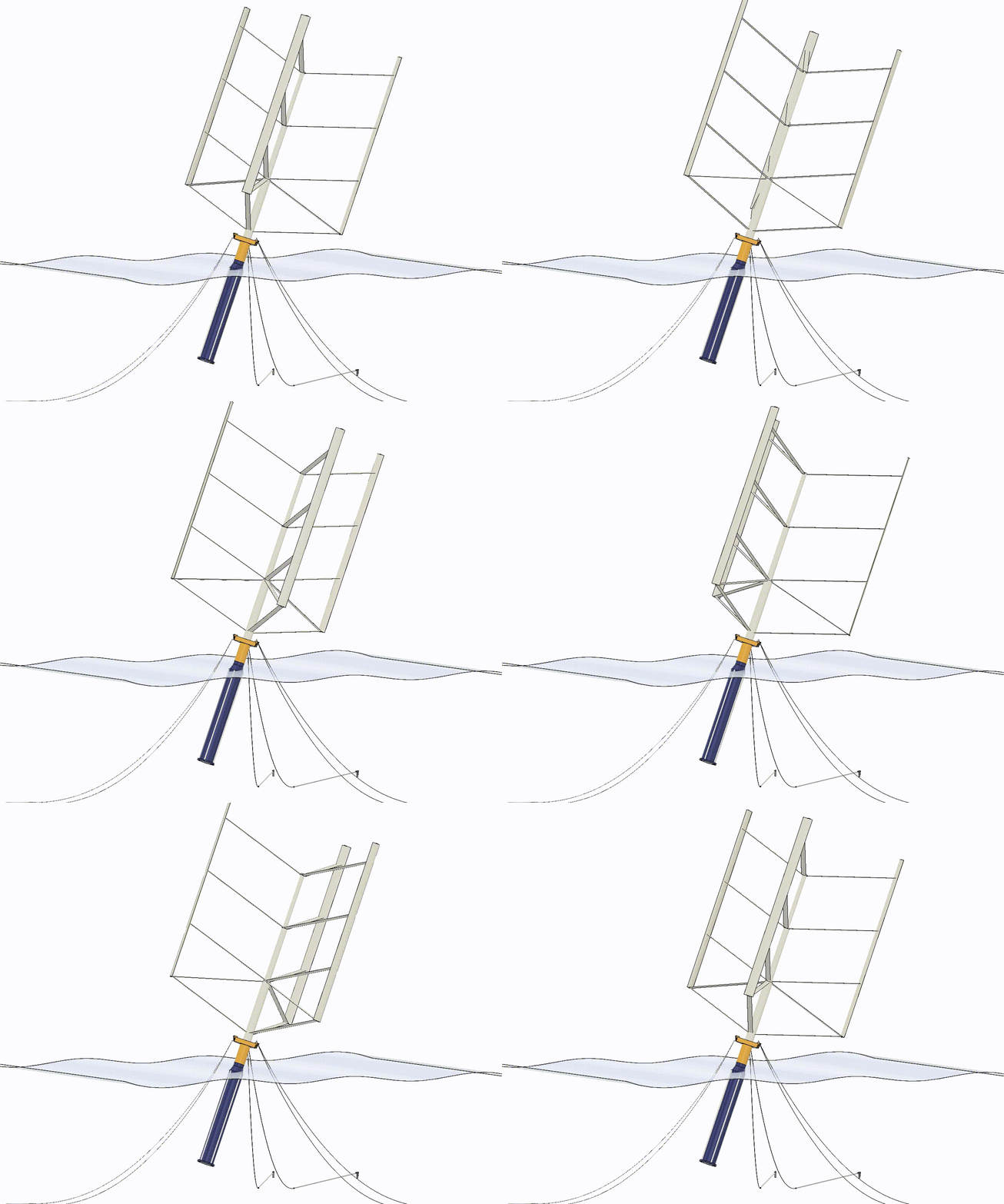
The company is also developing tidal and ocean current turbines as well as a rotary wave power turbine.
Investors call it an effort to rebuild the wind turbine supply chain
The pre-Series B round drew participation from companies including the Development Bank of Japan (DBJ), Sumitomo Heavy Industries and Mitsubishi Gas Chemical Company, along with individual investors.
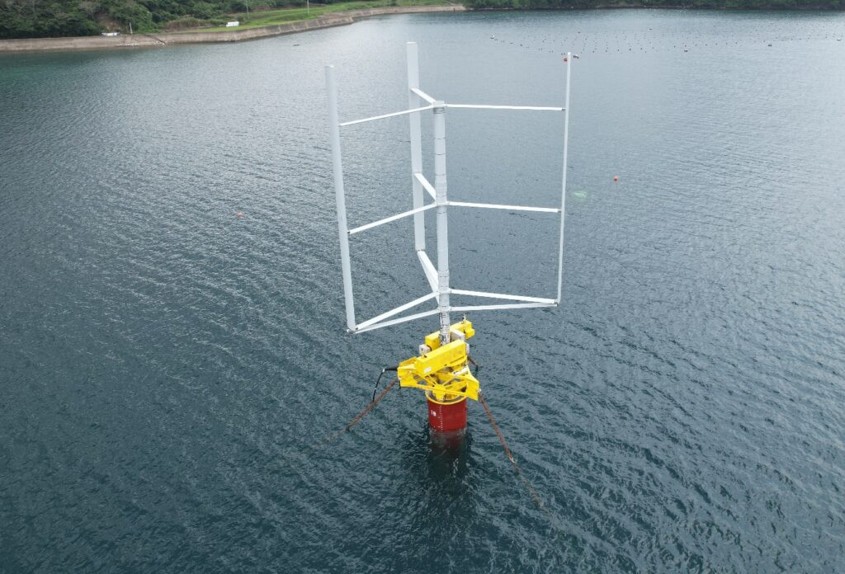
The funds will be used for “preparation of a large-scale offshore test unit, building on the small-scale offshore test unit currently undergoing demonstration in Nagasaki Prefecture.”
Yuki Takemori, General Manager of the Innovation Investment Department at DBJ, one of the investors, commented that “the FAWT that Albatross Technology is developing is not only a bid to bring down the cost of floating offshore wind power, but an effort that will rebuild Japan’s domestic wind turbine supply chain,” and that “DBJ will continue to support the company’s efforts to build a domestic turbine supply chain and create a new marine industry through the development of FAWT.”